A man from my daughter's church asked me the question I get most often now that I am three years into this hobby. He is 41, works the parts counter at a dealership, and has never soldered anything in his life. If you were starting from zero, he said, would you buy the ELEGOO UNO R3 Super Starter Kit or one of the ESP32 kits with more pins and a faster chip? I answered him in about ten seconds. I will give you the same answer, then show the work, because the reasoning is the part you can actually use on your own bench.
The ELEGOO kit is the one I would hand a beginner, and it is not close. Not because the UNO R3 is better hardware, because it is not, and not because the ESP32 is a poor board, because it is a very good one. It wins on the thing a starter kit is for. A kit has one job: get you to a working circuit before you decide this hobby is not for you, then keep you moving in an order that builds on itself. This one does that with 22 or more guided lessons in a single PDF, a box whose parts match those lessons one for one, and example code you can open in the Arduino IDE the same evening you unbox it. An ESP32 kit assumes you already know why you would want Wi-Fi on a microcontroller.
| ELEGOO UNO R3 Super Starter Kit | A typical ESP32 starter kit | |
|---|---|---|
| Board and clock | UNO R3 at 16 MHz with 2 KB of SRAM | ESP32 module with Wi-Fi and Bluetooth on the chip, several times the clock speed and far more memory |
| Wireless | The listing's wireless field is infrared, so an IR remote and receiver, not networking | Wi-Fi and Bluetooth built into the module |
| Lesson structure | 22 or more guided lessons in one PDF, in a fixed order, with the example code included | No single curriculum; you assemble a path from vendor wikis, GitHub repos and forum threads |
| Parts versus instructions | The box and the tutorial are the same list, down to the pre-soldered LCD1602 header and the breadboard power supply | Varies by seller; kit contents and example code are often written by two different people |
| Logic level | 5 volt logic, which tolerates the mistakes a first breadboard produces | 3.3 volt logic, and the pins do not tolerate 5 volts fed back into them |
| Headroom later | 2 KB of SRAM and 16 MHz, which you will notice once a display and two sensors are on the same board | Enough memory and speed for a small web page, a phone connection and a display at the same time |
| Time to a first working circuit | One evening: install the IDE, open lesson one, blink an LED | Usually several evenings of toolchain, board definition and pin map before the first reliable blink |
| Best for | Learning the fundamentals in order, starting from nothing | Someone who already has the fundamentals and wants wireless in the build |
Where the ELEGOO Kit Wins
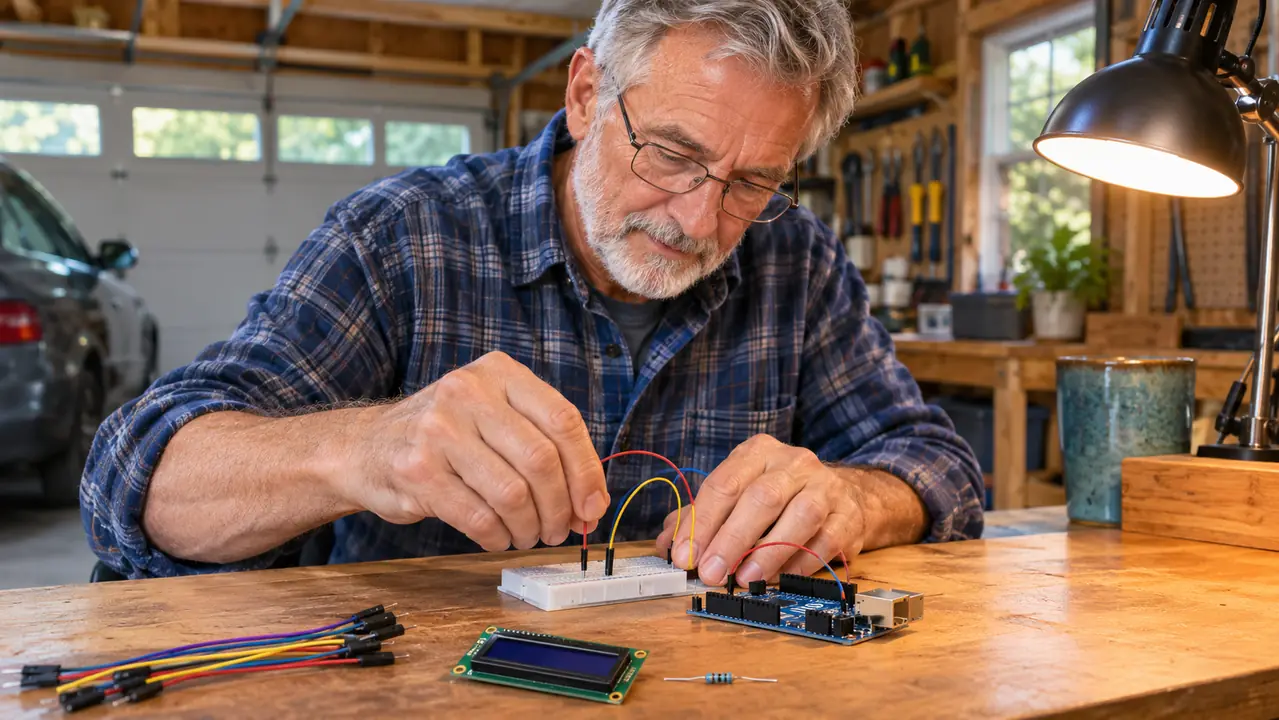
The first advantage is sequence, and I do not think it can be overstated. Mine arrived in April 2024 and I worked the tutorial in order over about four months of evenings, an hour at a time, and not once did I have to stop and order a part to finish a lesson. Lesson one is an LED. A few lessons later you are reading a button and understanding why the resistor is there. Somewhere in the middle you have a temperature sensor and a distance sensor wired up, then a servo sweeping through its range, and by the end an LCD1602 character display running on your own jumper wires. The display in this kit ships with its header already soldered on. That sounds like a small convenience until you have watched somebody try to solder sixteen pins in a row without bridging two of them.
The second advantage is voltage, and if I could tape one note above a beginner's bench it would be this one. The UNO R3 runs 5 volt logic, which is the forgiving side of the fence. The ESP32 runs 3.3 volt logic and its pins do not tolerate 5 volts pushed back into them. In May 2024 I wired an LED without its resistor and burned it out. That was a beginner's mistake that cost me one LED and taught me the lesson for good. On a 3.3 volt board the same class of mistake, a sensor output feeding a pin it should not feed, or a jumper landing one header over, is more likely to cost you the board. A beginner is going to make those mistakes. A beginner should make them on the part of the bench that survives.
The third advantage is that the parts outlive the lessons. The listing describes a breadboard power supply and a display whose header is already attached, and what it does not say is that every resistor, button, LED, jumper and sensor in the box becomes your stock afterward. Three years on, the resistors I reach for first are still the ones that came in that kit. A kit that turns into a shelf of usable parts keeps earning after the tutorial ends. A kit that turns into a drawer is a kit you bought twice.
Where the ESP32 Kit Wins
The ESP32 wins on capability, and I want to be straight about my standing here. I have never owned an ESP32 board or kit. Everything I say about it comes from listings and from reading build threads, not from a board on my own bench. What the listings show is a module with Wi-Fi and Bluetooth built into the chip, substantially more memory and flash than the UNO R3 carries, and a clock several times faster than the 16 MHz on the ELEGOO board. The UNO R3 has 2 KB of SRAM. If your project needs to serve a page, talk to a phone, or push a lot of text onto a display, you will run into that number and you will feel it.
The second thing the ESP32 gives you is a shorter path to the projects people actually want to build now. A garage temperature logger you can check from the kitchen is a sensor and a few lines of code on an ESP32. On the UNO R3 it is that same sensor plus a way to get the reading off the board, and the honest answer is usually a serial cable to a laptop that has to stay plugged in. I built that logger myself and I built it on a Raspberry Pi 4 instead. That tells you where the UNO R3 stops being the right tool. It is a fine teaching board. It is not a connected device board.
The third advantage is the size of the crowd around it. The ESP32 has a large library ecosystem, a lot of published projects, and a community that has already hit whatever problem you are about to hit. On the UNO R3 you get the same help in a different form: a tutorial that anticipates the problem before you reach it. Those are two different kinds of assistance. One requires you to describe your problem well enough to search for it. The other requires you to keep reading. In month one, the second kind is worth more. In month twelve, they are close to even.
Twenty-two lessons in a fixed order beat a more capable chip and a wiki, at least for the first four months.
The kit I would hand a 41-year-old who has never soldered
The ELEGOO UNO R3 Super Starter Kit is the one on my bench and the one I recommend first. 22 or more guided lessons, parts that match them one for one, a pre-soldered LCD1602 header, and 5 volt logic that survives the mistakes every beginner makes in month one.
Amazon Check Today's Price on Amazon →Who Should Buy Which
Buy the ELEGOO kit if you have never built a circuit. If you cannot tell a resistor from a capacitor by sight, if you have never opened the Arduino IDE, if the words breadboard and header are new to you, the sequence is worth more than the chip. Buy the ESP32 kit if you have already blinked an LED on a breadboard and understood why the resistor was there, and if the project in your head involves a phone, a browser, or a battery-powered sensor out in the yard. Buy neither if what you actually want is a robot that follows a line, because a car kit is a different purchase and I would rather you spend on the thing you will finish.
If you are somewhere in the middle, buy the ELEGOO kit now, work it end to end, and pick up an ESP32 board later with a clear idea of what you want it to do. Two boards, one curriculum, no wasted evenings. That is the path I would take if I were starting again next week, and it is the path I described to the man from church. He bought the ELEGOO kit. I do not know yet whether he will finish it, and neither does he, but he has a lesson order on his bench and a reason to sit down on a Tuesday.
What the First Month Looks Like on Each
On the ELEGOO kit, the first month is lessons. Week one you install the IDE on your laptop, fight the driver for twenty minutes, and get an LED blinking. Week two you are reading a button and understanding pull-up resistors because the lesson made you. Week three you have a temperature sensor printing numbers to a serial monitor and you start noticing that the numbers drift when you put your thumb on it. Week four you are driving a servo and you have opinions about delay timing. You are never asked to make a decision about which library to install or which board definition to select. Those decisions are made for you, which is the entire point of a curriculum.
On an ESP32 kit, the first month is mostly setup, and how much of it you spend there depends on the seller. You install a board manager package, you pick a board definition from a list with more entries than you expect, you learn that some USB cables carry power but not data, and you learn that the example sketch you found was written for a different pin map than the one on your board. None of that is hard once you know it. All of it is hard when you do not yet know what a pin map is. The people I see succeed with an ESP32 as a first board are usually the ones with a friend on the other end of a text message.
By the second month on the ESP32 the picture does reverse. Once the toolchain is set up and the pin map is understood, the board stops getting in your way in a manner the UNO R3 cannot match. You can put a small web page on it, you can send readings to a phone, you can run a display and a sensor on the same board without counting bytes. That is the payoff for the setup pain, and it is a real one. It just arrives after a wall that a beginner has no way to climb alone.
The Detail That Usually Decides It
If I had to name one detail that decides which kit a person should start on, it is not the chip. It is whether the parts in the box are the parts the instructions use. The ELEGOO tutorial and the ELEGOO box are the same list. Every lesson has its components, and the listing backs it with a 22 lesson structure built around an LCD1602 with a pre-soldered header and a breadboard power supply, so you are not inventing a power rail on lesson three. With a generic ESP32 kit the box and the instructions are often from two different sellers, and the gap between them is where beginners quit. Not because they are not smart enough. Because the fourth evening in a row spent troubleshooting a wiring diagram that does not match your board is a terrible way to spend an evening.
The other detail is what the board expects from you. The ELEGOO listing's wireless compatibility field says infrared, which in practice means an IR remote and a receiver, not a network connection. That is not a weakness in a teaching kit, it is a boundary, and boundaries are useful while you are learning. On the UNO R3 you learn digital input and output, analog input, and timing without a network layer sitting between you and the pin. Add Wi-Fi on day one and every bug becomes ambiguous. Is the sensor wrong, the wiring wrong, or the connection dropping? A beginner cannot tell those apart yet. A fixed curriculum removes the ambiguity on purpose.
What Neither Kit Will Do For You
Neither kit will make you an engineer, and I say that as a man who spent 34 years as an avionics technician before he ever touched a hobby microcontroller. What the ELEGOO kit gave me was a vocabulary and a habit: check the voltage before you trust the code, read the schematic before you move the jumper. That habit came from repetition, not from the board. If you buy either kit and let it sit on the shelf, you will have bought a box. The kit is not the education. The evenings are the education.
Neither kit replaces a meter, either. Mine is a digital multimeter I bought in February 2024, before any of this, and I have used it on every build since: continuity on a suspect jumper, DC volts on the rails, resistor values before they go into the breadboard. If you are buying a first kit and you do not own a meter, put one on the list before you buy the second kit. You can learn a great deal with a blinking LED and a tutorial. You cannot learn why the LED is not blinking without a way to measure.
Start with the curriculum, not the chip
If you are learning from zero, the ELEGOO UNO R3 Super Starter Kit is the shorter road to a circuit that works. Work the 22 or more lessons in order, keep the parts as stock, and move to a wireless board when you have a project that needs one.
Amazon Check Today's Price on Amazon →