
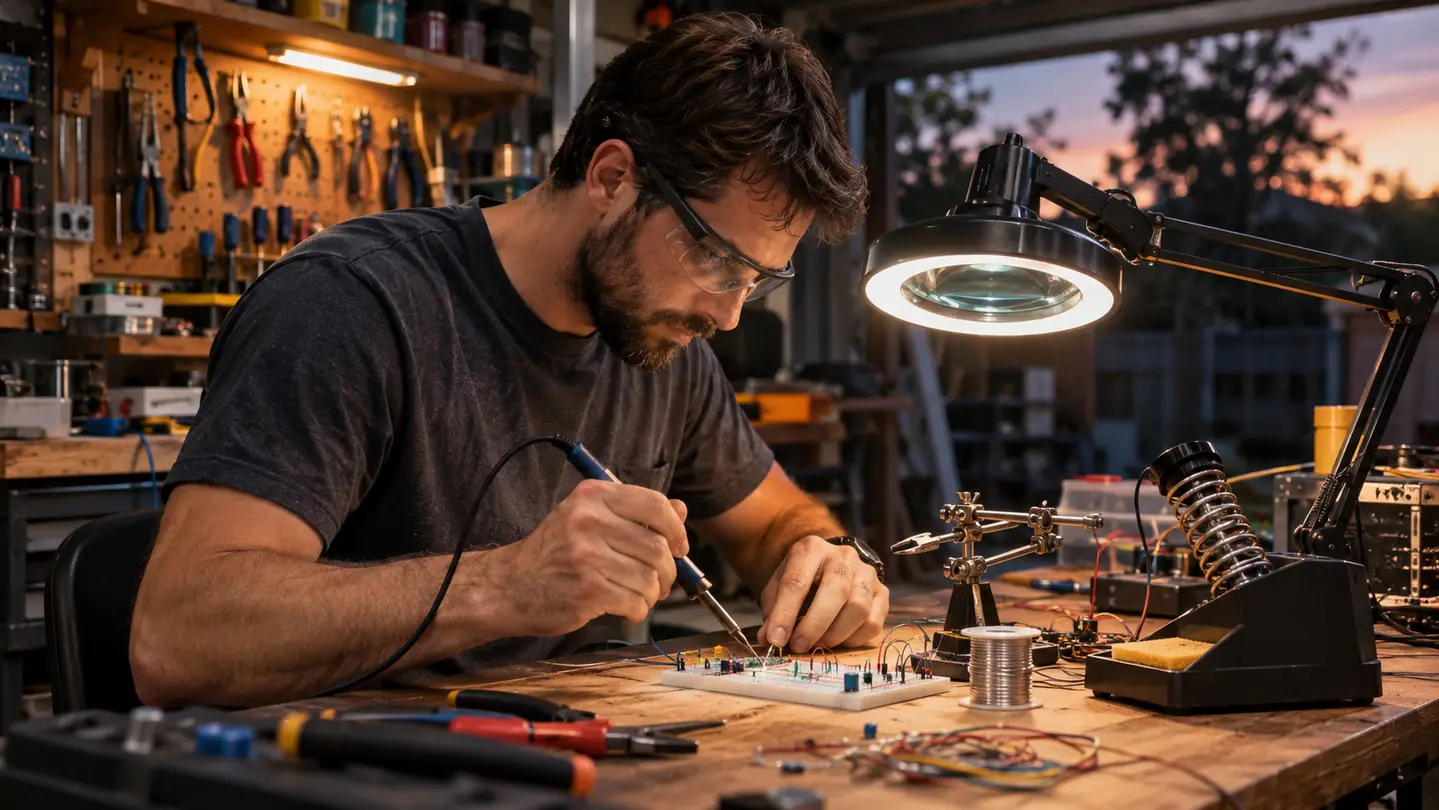
The week I retired from the hangar, Carol asked what I was going to do with my mornings. I told her I had no idea, which was true. For 34 years I had troubleshot wiring harnesses and circuit boards for aircraft, and the idea of doing any of it for fun sounded about as likely as me taking up watercolor. Then April 2024 came around, and I bought the ELEGOO UNO R3 Project Super Starter Kit. I wish I had bought it five months earlier, the week I retired.
My work had been aircraft systems, not Arduino. I knew how to read a schematic and how to chase a bad ground, but I had never touched a hobby microcontroller. The ELEGOO kit sat on the bench in its box for two evenings before I opened it, mostly because I expected the instructions to assume I already knew things I did not. They did not. The PDF tutorial starts at the beginning and walks through 22+ guided lessons. The box has the UNO R3 controller, an LCD1602 with a pre-soldered header, a breadboard power supply, and the small parts the lessons call for. I checked the parts against the list before I started. Everything was there. The pre-soldered header saved me a job I do not enjoy.
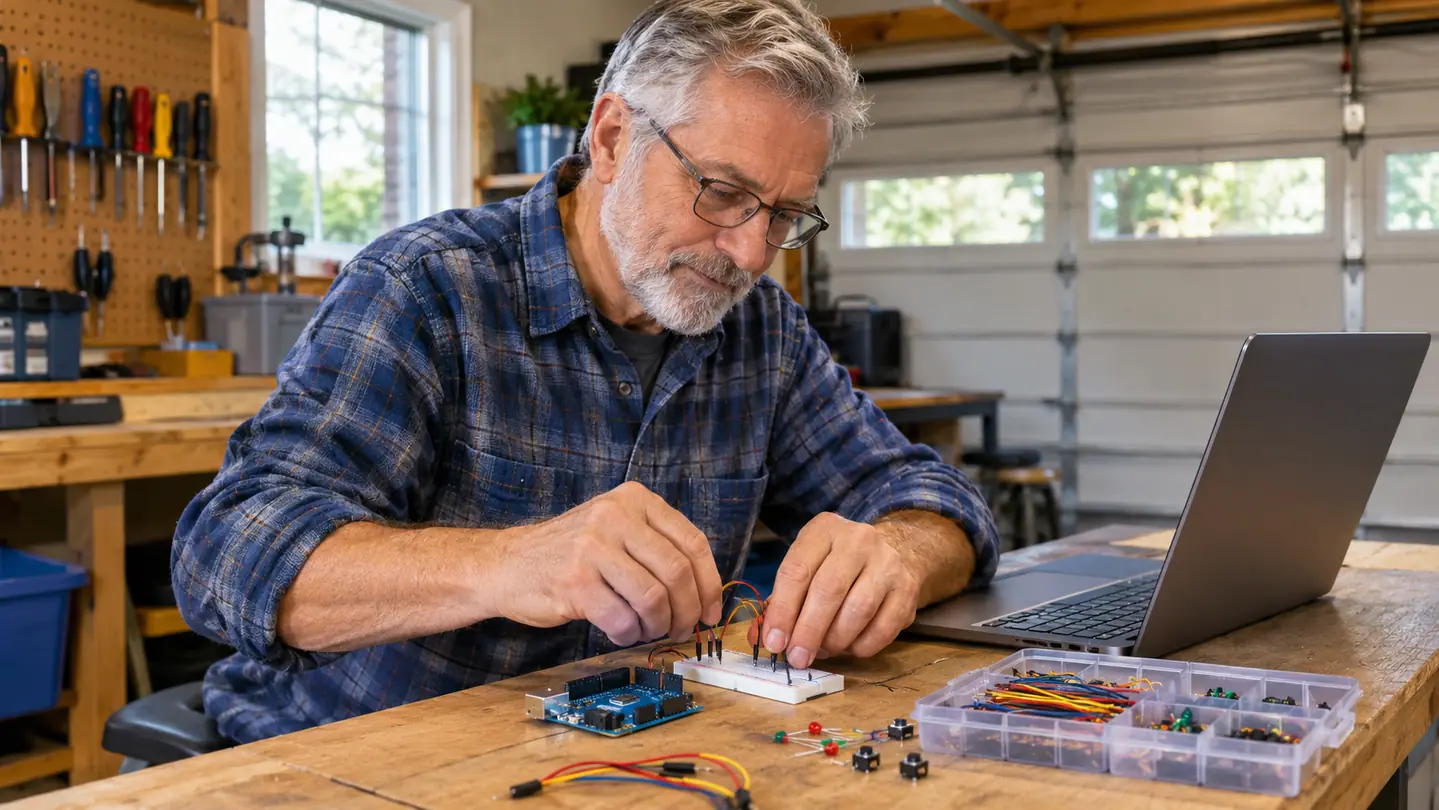
The first lesson was an LED blink. I wired it without its resistor and burned the LED out. That was May 2024, about a month in. One LED, nothing else. I put a new one in with the resistor, and the lesson worked exactly as the tutorial said it would. That was the moment the kit stopped being a box of parts and started being a way to spend an evening.
What surprised me was the order of the lessons. You start with output, then digital input and output, then the LCD1602, then reading temperature and distance, then moving a servo. Each lesson gives you the example code in the Arduino IDE and a circuit diagram. The code is not a mystery you have to reverse engineer. You can read it, change a number, and watch the result on the bench. The servo lesson was the one that made the light go on for me. A servo does not just turn on and off. It moves to a position, and the code tells it where. That is a different way to think about an output than a blinking LED.
I am not a patient man by nature, but avionics teaches you to check the small thing before you check the big thing. The kit rewards that habit. When a circuit did not work, it was almost always a wire in the wrong row or a pin number I had misread. The UNO R3 controller itself never gave me trouble. It still runs the same example code today, more than two years later.
I burned exactly one LED in four months of evenings, and that was because I skipped the resistor, not because the instructions left me guessing.
The kit that made a retired avionics bench feel useful again
If you are starting from zero and want lessons that begin at the beginning, this is the ELEGOO kit I bought in April 2024. It is still my breadboard stock today.
Amazon Check the ELEGOO kit on Amazon →The parts held up. I have kept the UNO R3 controller, the LCD1602, and the breadboard power supply as my breadboard stock. The controller lives in the parts drawer cabinet now, and I pull it out when I want to test a small idea without dragging out the bigger board. The LCD1602 still gets used for bench readouts. The box is 8.3 by 5.5 by 1.97 inches and weighs 1.2 pounds, so it does not take over the bench. I did not expect a starter kit to become shop stock, but that is what happened.
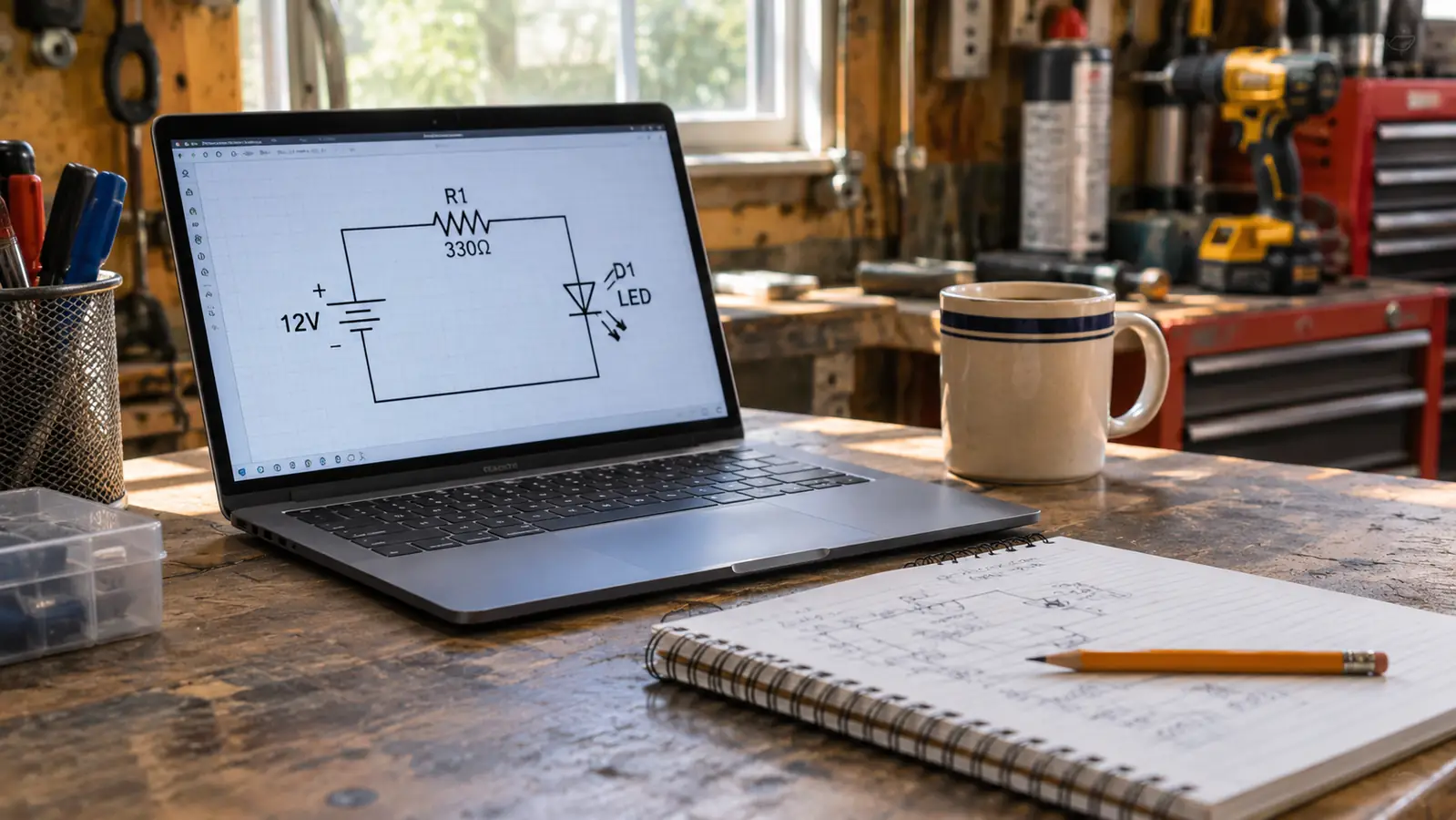
Where beginners get stuck is not the code. It is the wiring. The example code is right there in the Arduino IDE, and the tutorial shows the circuit, but you still have to match the pin numbers to the diagram. I did that wrong once with a sensor on the robot car, not with this kit. With the starter kit, my mistakes were simpler. A wire one row off. A resistor value misread. The tutorial does not make you feel slow. It says what to connect and where. If you can read a schematic or even if you cannot yet, you can follow it.
A friend asked me if the kit teaches you to be an engineer. No. It teaches you what a digital input is, how a servo gets its signal, and why a resistor matters. That is a real thing to learn at 63, or at 43, or at 73. I do not sell these kits, I do not teach a course, and I do not make money from builds. I am just a retired technician who wanted a reason to keep his hands busy and his mind on something small and fixable. I am not claiming this leads to a job. I am saying it is a good way to spend a winter.
What stays on the shelf and what gets used again is the real test of a kit. The projects I built from the lessons that stayed with me are the temperature and distance lessons and the LCD1602 display. The projects that did not stay were the ones I built once to prove I could. That is fine. A starter kit is not a shelf of finished gadgets. It is a set of parts and a set of ideas you can return to. The ELEGOO kit passed that test for me.
What I'd Tell You If We Were Sitting at My Kitchen Table
If you are sitting across from me with a cup of coffee and a catalog open, I would tell you to buy the kit before you buy a shelf full of extra parts. I would tell you to do the first three lessons before you decide whether this hobby is for you. I would tell you that the LED you burn will not be the end of the world, and that the resistor is not optional. I would tell you that 22+ lessons is enough to keep you busy for a few months of evenings, which is exactly what I needed after 34 years of shift work. And I would tell you that the point is not to become an engineer. The point is to understand the thing in front of you. If that sounds like a good use of a winter, the ELEGOO kit is a sensible place to start.
Start with the lessons, not the shopping list
The ELEGOO UNO R3 Project Super Starter Kit is the one I bought in April 2024. It is still on my bench, still teaching me small things.
Amazon See the kit on Amazon →