
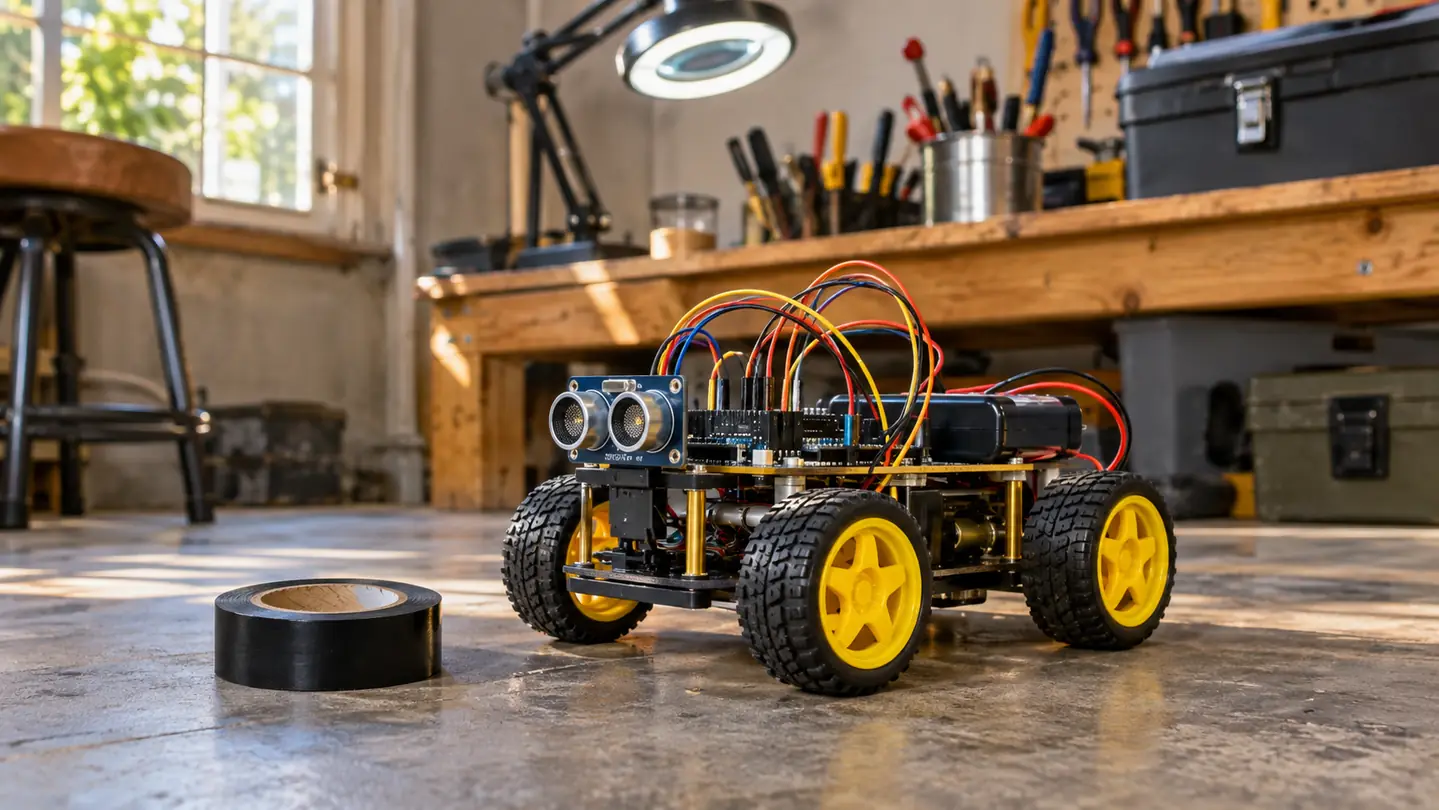
Buy the ELEGOO Smart Robot Car Kit V4 if you want a working robot this weekend. Buy a loose-parts chassis and separate components if you already know which motor driver you want and a boxed kit cannot become the machine you have in mind. That is the short answer, and for most people who land on this page it is the whole answer.
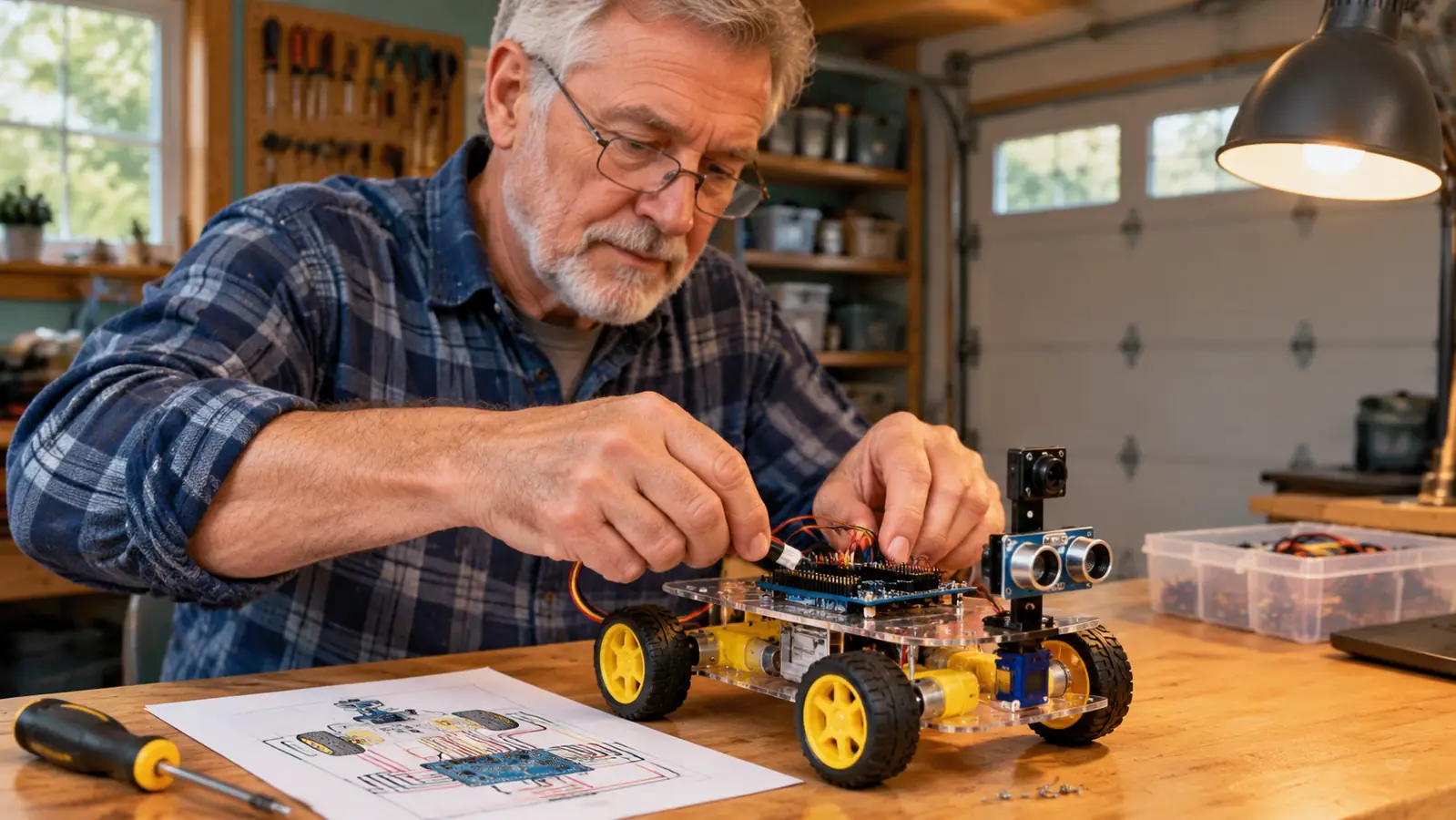
I built the ELEGOO kit in February 2025 over two Saturdays, about six hours of assembly at the wooden bench along the back wall of my garage in Everett, Washington. I have never built a robot from a bare chassis and a bag of loose parts. So you should know what you are getting on that side of the comparison: listing specs, forum build logs, and thirty-four years of reading schematics for a living, not a build of my own. I will flag that wherever it matters, because the difference between having built something and having read about it is the only thing that makes a comparison worth your time. And the choice is less obvious than it looks. A kit is not simply a bag of parts with a label on it. It is a preselected set, an illustrated tutorial, and example programs that are known to work together. A loose chassis is parts plus your judgment, and your judgment is exactly the thing you are trying to build.
| ELEGOO Smart Robot Car Kit V4 | Loose-parts DIY chassis | |
|---|---|---|
| Time to a running robot | About six hours over two Saturdays in my case, with every part already in the box | Days to weeks, plus a shipping wait every time you discover a missing piece |
| Parts sourcing | One order, one box, everything matched to everything else | Plates, motors, driver board, controller, wiring and hardware bought line by line and matched by you |
| Wiring mistakes | Keyed XH2.54 connectors and an illustrated diagram showing the correct run | Loose leads and bare headers, with nothing stopping a reversed plug |
| Debugging help | A known-good baseline: tutorial, example programs, and a wiring picture to compare against | No baseline at all, so every fault is yours to isolate from scratch |
| What you learn about part selection | The choices are made for you, quietly and competently | You spec the motor, pick the driver, and feel the consequence of getting it wrong |
| Freedom to change the design | Plates with mounting holes in a fixed layout, so new sensors live inside that layout | Any plate, any sensor, a second deck, a different wheel size, any idea you have |
| Use of parts you already own | Largely a duplicate set if your drawer is already stocked | Built around what is on hand |
| Replacing a failed part | Order the kit part or a compatible equivalent | Swap in anything you like, because you chose it in the first place |
| Best for | A first machine that has to actually run | A builder with a specific design and a stocked bench |
| Stated age range | Listing says 12 years and up | No rating exists, it is whatever you assemble and supervise |
Read the winner column the way I wrote it, because I did not hand the kit every row. The kit takes the rows about reaching a running machine. The loose chassis takes the rows about understanding why the machine is built the way it is. Those are two different educations, and pretending one of them is fake would make this the kind of comparison nobody should trust.
Where the ELEGOO Kit Wins
The parts count is the first thing, and it is larger than people expect. Plates, motors, a motor driver board, a controller board, the mounting hardware, and every cable, all in one box, all matched to each other. The whole set weighs 1.23 kg and the box measures about 8 by 7 by 6 inches, which does not sound like much until it is open on the bench and you realize every small piece has a place to go. I emptied mine onto a bath towel and sorted it in the order the tutorial listed before I picked up a screwdriver. That took most of forty minutes and it saved me from digging through a pile for a six millimeter screw at the exact moment I needed one. A loose build is that same list with one difference: you buy each line separately, and then you find out whether the driver board can supply what the motors actually pull when the wheels are blocked. I watched a friend order motor drivers three times in a row for exactly that reason, a week of evenings lost with each order, and he is not a careless man. He simply had no way to know until the parts were on his bench.
Second is the wiring. The connectors on this kit are keyed XH2.54, which means a cable only fits the port it was cut for. Keyed is not the same as foolproof. On my first Saturday I pushed one sensor cable into the wrong port and the car sat there doing nothing until I opened the tutorial, found the wiring diagram, and moved the plug. Ten minutes, and nothing was damaged. What rescued me was not the keying. It was having a diagram that showed the correct run so I could hold it beside what I had built and see the difference with my own eyes. Thirty-four years of tracing harnesses in a hangar taught me to follow a wire end to end before I power anything, and I still put that plug in the wrong hole. The printed diagram is what closed the gap, and on a scratch build there is no diagram because there is no standard run to print.
Third is the baseline, and this is the part beginners underestimate. When a kit car does not move, you have a reference that is known to work: an illustrated tutorial, example programs that thousands of other people have already run, and a wiring picture to compare against. I worked the tutorial in the order printed and ran each example program as I finished the section it belonged to, so there was never any doubt about what had last worked. That single habit is worth more than any tool on my bench. When a scratch build does not move, you have your own decisions and nothing else. Every fault is yours to isolate, and a beginner cannot tell a software fault from a wiring fault from a part that arrived wrong. That is what a loose chassis actually asks of you, and it gets paid in evenings.
Where the DIY Chassis Wins
Now the other side, and it is a real one. A kit makes a hundred decisions for you and does it quietly. Which motors. Which gear ratio. Which driver. Where the sensors sit and why. What you get is a machine that works, and you do not get the reasoning behind it. On a loose chassis you spec the motor, you choose the driver, and then you discover what stall current means because you picked a driver that cannot deliver it. Take gear ratio alone. A kit hands you a motor already paired to a gearbox, a wheel and a plate, and the pairing simply works. Choose it yourself and you are weighing torque against speed against current draw, and that arithmetic does not forgive a guess. I have done it on paper at this bench and gotten it wrong on the first pass. That lesson stays with you in a way no tutorial paragraph ever will.
The second advantage is freedom. The plates in a kit have mounting holes in a fixed layout, and every sensor you add afterward has to live inside that layout. A loose chassis accepts any plate, a second deck, a different wheel, a bracket you bent yourself, and an entirely different idea of what the robot should be. If your drawer is already full of parts from other projects, the kit is partly asking you to buy duplicates of things you own. I felt that plainly, because the parts drawer cabinet behind my bench already held jumper wires, headers and a spare controller, none of which a boxed kit was going to use.
The third advantage is ownership. When a part fails two months in, you know exactly why it is there, because you chose it and you had a reason at the time. You can also replace it with anything you like instead of hunting the equivalent of a kit part. A kit part that dies tends to send you looking for the same part number, which is fine, and it is not the same as knowing what else would have worked and why. That is worth something, and it is worth more the better you get at this.
The robot that runs before the weekend is over
Six hours of assembly, keyed connectors, an illustrated tutorial, and example programs that already work. That is what the ELEGOO kit is selling, and it is the stage most beginners never get past on a scratch build.
Amazon Check Today's Price on Amazon →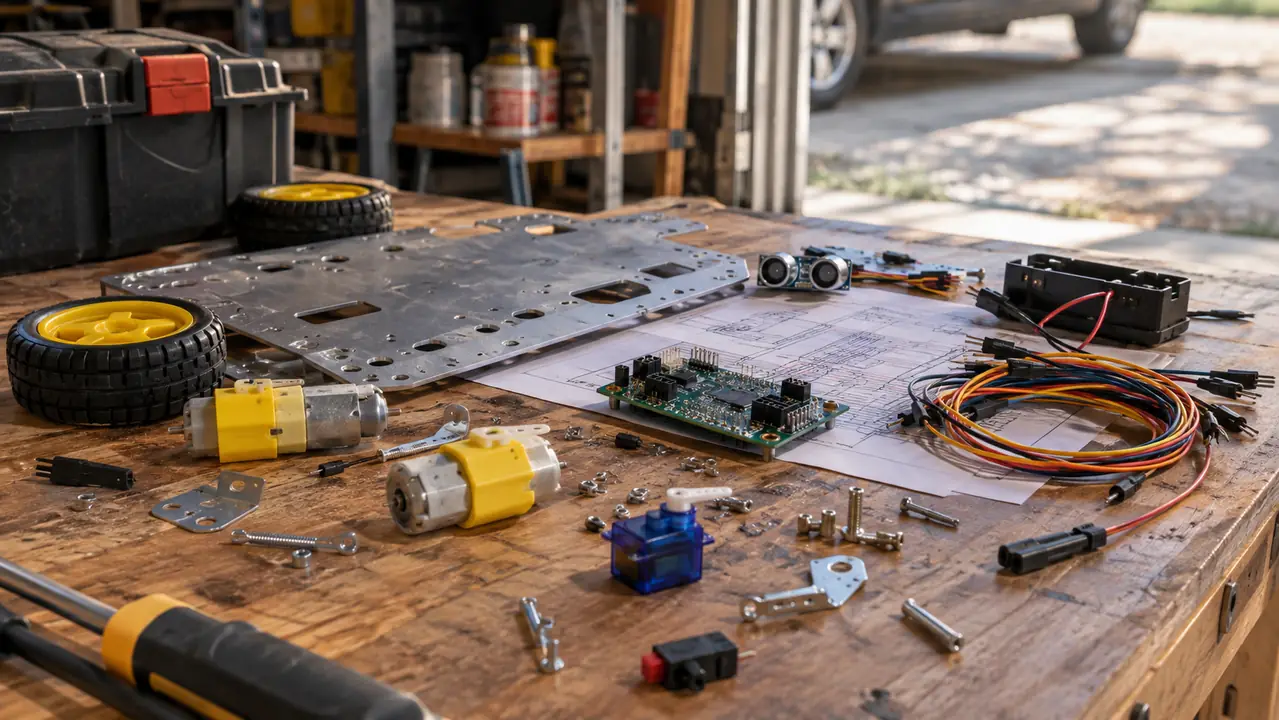
What Neither Path Tells You Up Front
Neither path is where you stay. The sequence I would give my younger self is the kit first and the loose parts second. Build the ELEGOO car, get it tracking a loop of black tape on the concrete, then take it apart and rebuild the pieces you understand onto a plate you cut yourself. You end up with the finished machine and the reasoning, in that order. Do it that way and the second build has a reference in your head, which is the one thing the first build could not give you.
The other thing nobody mentions is that scratch builds tend to stall a long way in. The chassis rolls, the code compiles and uploads, and then one sensor behaves strangely and the whole project goes on a shelf. Not from lack of ability. From lack of a reference to compare against and no finished state to aim at. Every builder I know has that shelf. Mine holds projects that stalled over a step I could not check, and not one of them stalled because I was not clever enough.
And that is the argument that decides it for most people. A robot you finish gets used again. A robot you abandon does not. The kit's entire job is to get you to a finished state, because a finished machine is the thing that makes you want to change it, add to it, and eventually design something of your own.
A kit gives you a finished state on day one. Once you have seen a working one, the faults in your own build look like faults instead of mysteries.
Who Should Buy Which
Buy the ELEGOO kit if this is your first robot. Buy it if you want a machine that follows a black line, steers around what is in front of it, sends live video back from the onboard camera, and drives from the app or the IR remote without a month of debugging first. Buy it if you are shopping for someone in the twelve and up range the listing names, and buy it if you learn by finishing things, which is a legitimate way to learn and far more common than the internet admits.
Buy the loose chassis and the separate components if you already own a controller and a drawer of hardware, if you have a specific machine in mind that no car kit can become, or if part selection is the exact skill you want to practice. Be honest about that last one. If you have never had a circuit work on the first attempt, the loose route will teach you patience, and it will not teach you robotics quickly.
Whichever way you go, do one thing before you order. Write down what the robot should do when it is finished. If the list is a black line on the floor, something ahead of it to steer around, and the app for driving, the box already covers it and you can stop shopping. If the list runs longer than that, you are designing, and designing wants loose parts and a plan for the parts you cannot yet name.
There is also the winter argument, and around here it is not a small one. A project that gets finished in two Saturdays is a project that survives to a third Saturday. That matters more than any spec sheet when the alternative is a box of parts sitting untouched on a bench until spring, and it matters most for the person who has never finished a build at all.
Start with the machine that works, then take it apart
The ELEGOO Smart Robot Car Kit V4 ships with the illustrated tutorial, the example programs and the wiring diagram. Build it once, learn what a working robot feels like, then start changing it.
Amazon See the kit on Amazon →