
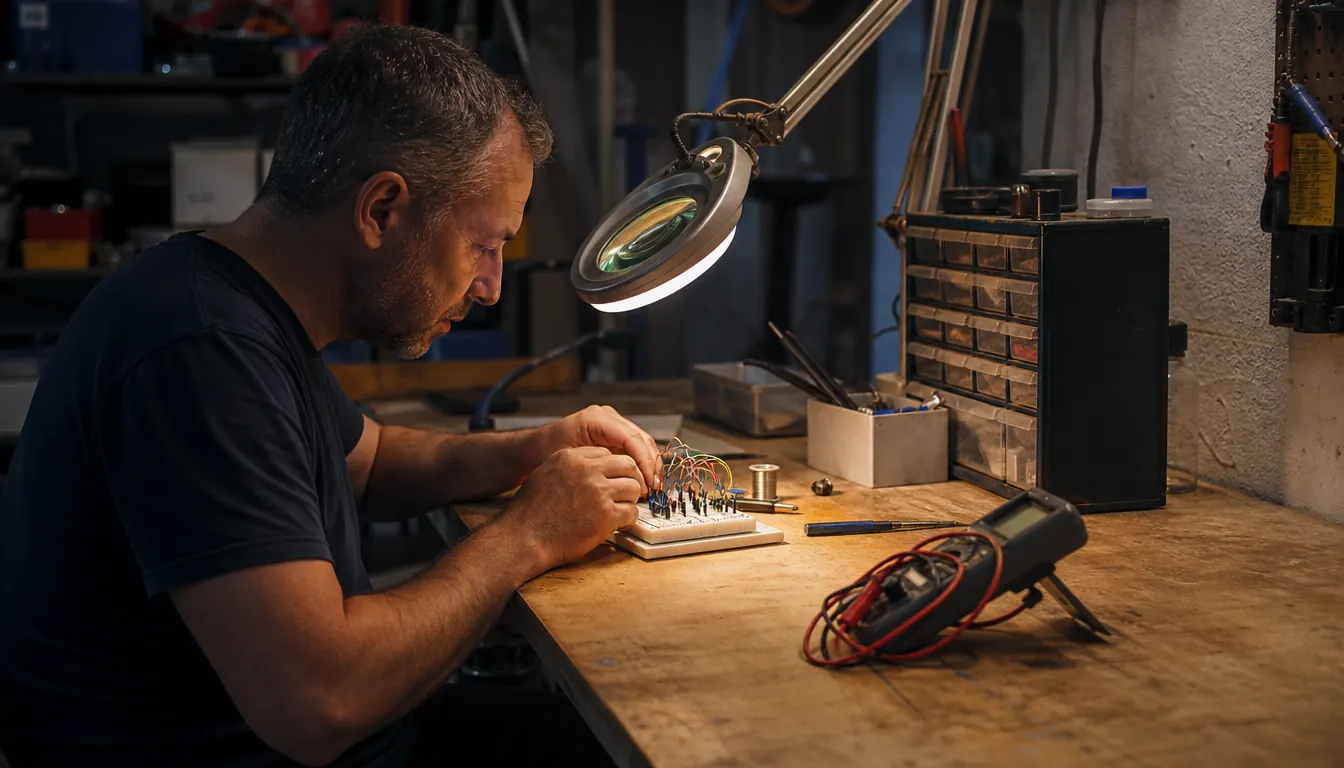
The short answer is that these are not the same tool wearing different clothes, and the one I would put in a beginner's hands is the AstroAI on my bench, not the clamp. A clamp meter reads current by closing a jaw around a single conductor. The AstroAI reads voltage, resistance, continuity and diode drop by touching two probes to the thing you are testing. For breadboards, robot car wiring, battery packs and resistor sorting, the probes are what you need. The jaws are not useless. They are aimed at a different job, one that mostly happens inside an electrical panel rather than at a workbench.
I should be straight about what I own before I compare anything. The AstroAI AM33D has been on my bench since February 2024, and it is the first multimeter I have ever owned in my own name. For 34 years I used shop meters at the hangar and handed them back at the end of a shift, so buying one for myself was a strange little milestone. I have never bought a clamp meter for the garage. Everything I say about clamps below comes from listings, from manuals I read at work, and from watching other people use them, never from one sitting in my parts drawer. The table is the fast version of the argument.
| AstroAI AM33D | Clamp meter | |
|---|---|---|
| Voltage and resistance | Two probes on the node, reading appears on the screen | Voltage through leads on most models, jaws are for current |
| Continuity and diode test | Both on the meter, used every session | Continuity usually there, diode test often missing |
| Current without opening the circuit | Meter goes in series, so the circuit gets broken | Jaw closes around one conductor, nothing disconnected |
| One-handed work in a tight space | Two probes, two hands, eyes on both tips | One hand on the handle, eyes on the jaw |
| Small parts on a breadboard | Probe tips fit header pins and component legs | Jaws have nothing to close around |
| What it is built to sit in front of | A breadboard on a bench | An energised panel |
| First meter for a kit builder | Does the work the lessons actually ask for | Wrong tool for the first six months |
Where the AstroAI Wins
It wins on the bench, and the bench is where a hobbyist actually lives. Continuity is the check I use most. I put one probe on each end of a jumper wire that looks perfectly fine, listen for the tone, and know in two seconds whether the wire is lying to me. That single habit has saved me more evenings than any other. Diode test is the second. Plenty of clamp meters give you volts and amps and stop there, because a clamp was never designed to sit on a bench and check components one leg at a time.
The numbers are honest for what this meter is. Two thousand counts, a sampling speed of twice a second, and a backlit screen that matters more than I expected, because the corner of my garage where the bench sits is dim by five in the afternoon in November. The listing puts it at up to 500 volts and says it meets IEC 61010. Mine runs on the 9V battery that came in the box, and I have replaced that battery exactly once, in the spring of 2026. There is a low battery indication on the display, which is the sort of feature you only appreciate after a meter starts reading nonsense and you spend an hour blaming the circuit.
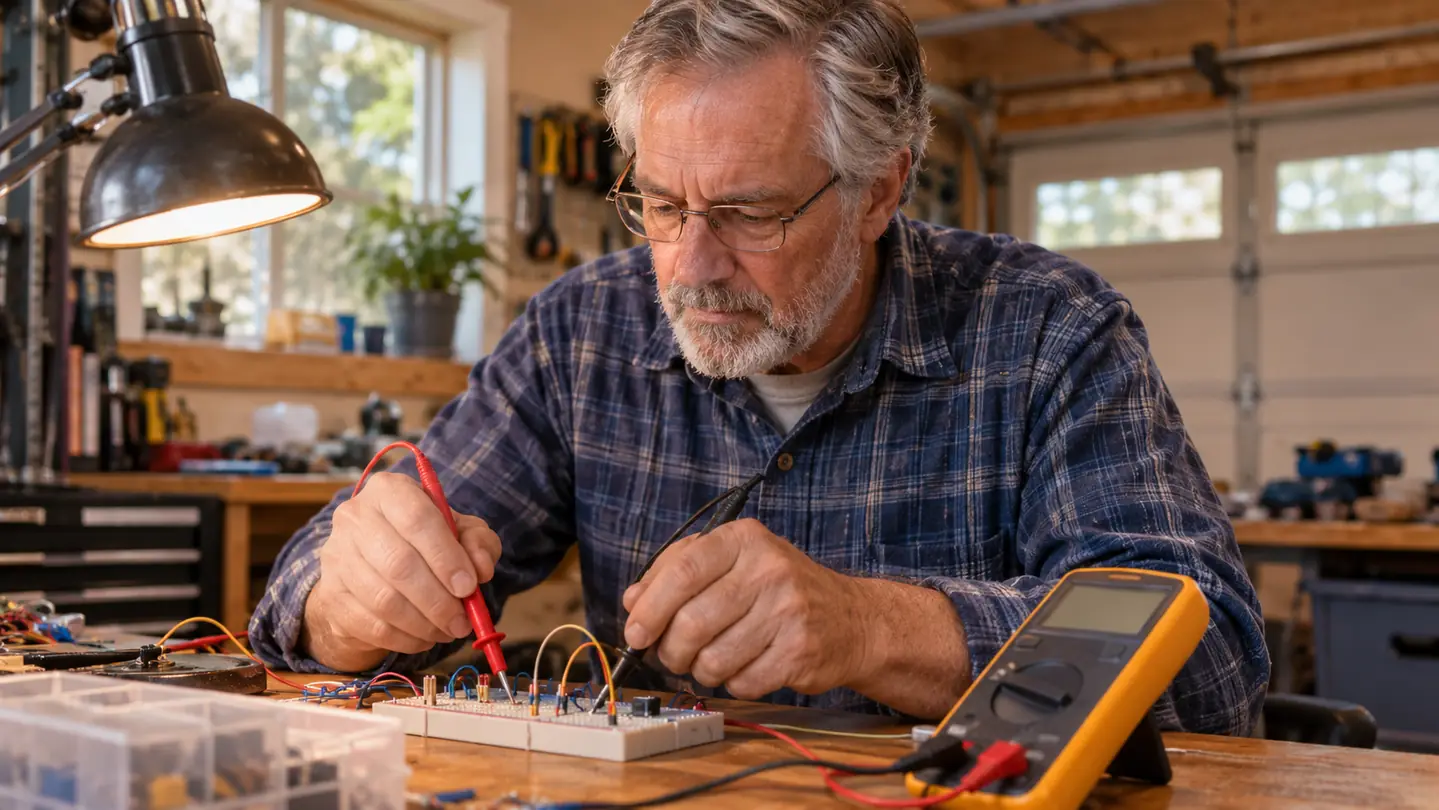
What it really wins on is the shape of the work. A lesson book asks you to check a resistor before it goes in, confirm a rail sits where it should, and prove a ground is really connected. Those three jobs are all probe jobs. The meter weighs about as much as a paperback, the two leads coil into the lid of a parts box, and it goes back on the bench without needing a case or a holster. Nothing about it is precious, which is exactly what I want from a tool I pick up six times in an evening.
Where the Clamp Meter Wins
Current, without a break in the circuit. That is the whole argument and it is a good one. To read amps with the AstroAI you have to put the meter in series with the load, which means opening the circuit and putting the meter into the path. To read amps with a clamp you close the jaw around one conductor and look at the screen. Nothing gets disconnected. Nothing gets unsoldered. On a wire carrying a real load, that is the difference between a two-second check and a twenty-minute one, and anyone who has done the twenty-minute version remembers it.
It also wins on one-handed work. A clamp is one hand on one handle with your eyes on the jaw, which matters when the other hand is holding a panel cover or a flashlight. And it wins on conductors you cannot easily reach with a probe tip, thick cable and crowded terminal blocks being the obvious cases. A probe needs exposed metal at both ends of the reading. A jaw needs a gap wide enough to close around one wire. When the wiring is dense, the jaw is the only one of the two that gets in there at all.
The honest concession is that none of this helps a beginner in the first six months. The kit lessons do not ask for amps on a live conductor. They ask for continuity, voltage and resistance, all of which are probe work. So the clamp is a real tool solving a real problem, and for most people reading this the problem is not yet theirs. That is not a knock on clamps. It is a statement about which job comes first on a bench.
The meter that gets picked up six times an evening
Two test leads, a backlit screen, and a continuity tone that settles an argument in two seconds flat. Mine has been sitting at the left end of the bench since February 2024.
Amazon Check Today's Price on Amazon →What a Clamp Meter Is Actually For
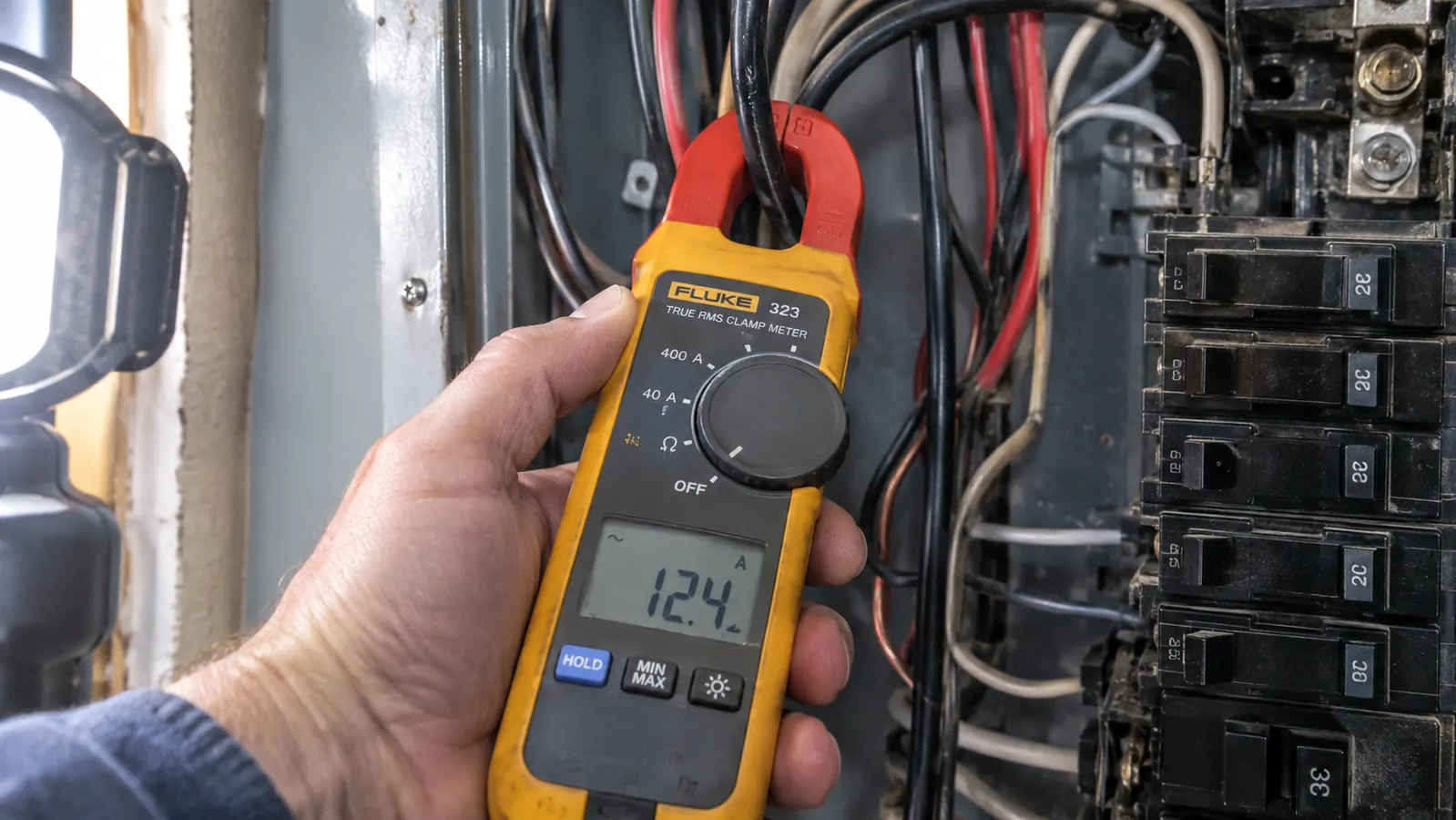
A clamp reads the field around a single conductor, which is why the jaw has to close around one wire and not a cable containing two. If current goes out on one conductor and comes back on another inside the same jaw, the two fields cancel and the meter reads near zero, which confuses people badly the first time it happens. The technique is to separate the conductor you care about. In a panel that means the individual wire, not the jacket with both conductors still inside it.
That is the job in one line: current on a circuit that is running, without shutting it down or opening it up. Chasing which breaker feeds a receptacle, checking a motor under load, watching a compressor pull current as it starts. At the hangar, clamps lived on the power carts and the shop distribution, and I used them there and handed them back at the end of the shift like everything else. Different bench, different tool, and no part of that work happens in my garage.
What the AM33D Actually Tells You on a Tuesday Night
Here is a real evening. The robot car stops tracking the tape loop I laid on the concrete, and it does it in the same place every run, which is a gift, because a fault that repeats is a fault you can chase. I do not start by rewriting code. I start with the meter. Battery voltage first, because a tired battery explains more strange behavior than any sensor. Then the 5V rail on the board, then continuity across each sensor lead, one at a time, with the car switched off and the wheels off the floor.
That order has never failed me and it costs about three minutes. The value of the AstroAI in that moment is not accuracy to four decimal places. It is that the reading appears immediately and the probes fit where I need them, on a header pin, on a battery terminal, on a resistor leg before it goes into the board. A clamp cannot do any of those three things. It would sit in the drawer while I did the actual work, and a tool that sits in the drawer is a tool I stop trusting.
The last thing I check is the thing I changed most recently. In this case it was one sensor lead I had re-seated the week before, and the fault was a connector that was mostly in. That is a ten-second fix once you know, and an hour of code reading if you do not. A meter does not make you clever. It just takes guessing off the list of things you are doing, and guessing is expensive on a Tuesday night when you wanted to be finished an hour ago.
A meter does not make you clever. It takes guessing off the list, and guessing is the expensive part.
The Reading That Trips Up Beginners
Current is where people get into trouble, so it gets its own section. Current is measured in series, which means the meter becomes part of the circuit. If the probes are across a battery while the meter is set for current, you have built a very small short circuit and you will learn something immediately, possibly with a smell. Voltage is measured across a component. Current is measured through the circuit. I still say that sentence to myself out of habit and I have been doing this since before the AstroAI existed.
The listing is honest about a limit worth repeating. This meter cannot test all AC current, and it cannot read AC voltage below 100mV. Those are not faults. They are the edges of a 2000-count hobby meter, and knowing where the edges are is most of what separates a person who trusts a reading from a person who guesses and hopes. Small signal AC is niche work that most kit builders never touch. Household mains is not this meter's job, and in two years and nine months I have never used it there.
What I Would Not Do With Either Meter
Neither instrument turns a person into an electrician. My rule is simple. I do not work inside household mains wiring, not with the AstroAI and not with anything else on this bench. The meter is rated to 500 volts per the listing and meets IEC 61010, and that is a statement about the instrument, not a permission slip for the person holding it.
Where the two genuinely differ in risk is the panel. A clamp is built so you can take a current reading with the circuit still energised, which is convenient and also the reason people get hurt doing it. If that work is not already familiar to you, the correct move is to leave the cover on and find someone who does it for a living. I have never used the AstroAI on household wiring and I have never needed to.
After Two Years and Nine Months, the Small Annoyances
Nothing has failed. The warranty runs three years and I have not needed it. What has aged is the pair of test leads, which get stiff in a cold garage and have a permanent curl in them now. The operating range on the listing is 32 to 104 degrees Fahrenheit, and a January evening in Everett sits right at the bottom of that, so I bring the meter into the house when the garage is going to stay cold for a week. That is not a complaint about the meter. It is a fact about unheated garages in this state.
The other honest note is resolution. Two thousand counts is plenty for a 5V rail and a battery, and this is not a lab instrument, so I do not ask it for four decimal places on anything. For the work on this bench it reads what I need and it reads it fast. The thin part of the package is the printed manual, and if a reading ever stopped making sense I would use the AstroAI support line before I started swapping parts. I have not had to make that call yet.
If I Were Starting Over
I would buy the same meter first, and I would buy it before the kit arrives rather than after. Half the value of a starter kit is the lesson where you learn to check your own wiring, and that lesson lands differently when you have the instrument in your hand on day one instead of a week later. I would also pick up a spare pair of test leads, since leads are the part that wears and a spare set means a worn lead never ends an evening early.
I would not buy the clamp at the same time. Two tools bought at once means one gets learned and one gets stored, and in my experience the stored one is the one that looked more impressive in the product photo. The clamp becomes worth its drawer space the day the work turns to current on a live conductor. Until then it is a thing you move out of the way to get at the meter underneath it.
Who Should Buy Which
If you are building a robot car, working through an Arduino lesson book, or sorting parts for a breadboard, buy the AstroAI. It is the meter that spends its life in your hand rather than in the drawer, and after two years and nine months mine still sits within reach at the left end of the bench, next to the soldering station and the magnifier lamp. If your work is current on a conductor you cannot open, or you are one-handed in a panel with a flashlight clamped in your teeth, buy the clamp and buy a good one. If you can only buy one and the work is a kit on the kitchen table, the answer is not close, and it is the probe meter.
Start with the meter the lessons actually use
Continuity, voltage, resistance and diode drop, in a body that weighs about as much as a paperback. Three year warranty, and mine has never needed it.
Amazon Check Today's Price on Amazon →