
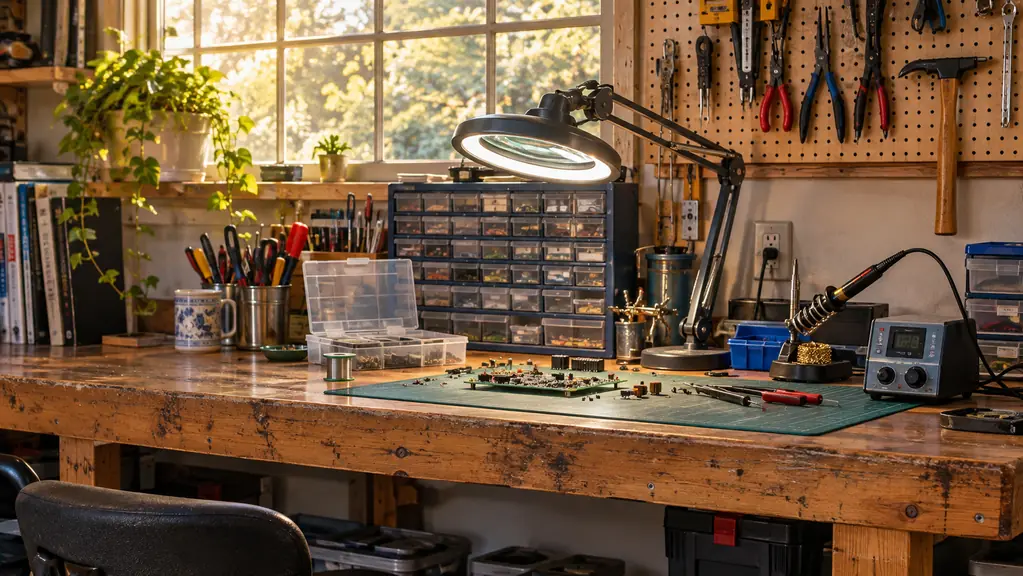
The first tool I bought after I retired was a multimeter. Not a fancy one. An AstroAI AM33D, 2000 counts, with a 9V battery in the box and a pair of test leads. I had spent 34 years using shop-issued meters on aircraft at the hangar and had never once owned one for the house. Carol asked me what it did. I told her it tells me the truth, which sounded dramatic until you have spent an entire afternoon guessing at a circuit that will not cooperate.
That is what a dead project really is, most of the time. Guessing. You reseat a jumper wire because it looks loose. You swap a part because it is the cheapest thing to swap. You talk yourself into believing the board is bad, order another one, wait four days, and find the same behavior when it arrives. Before February 2024 I did all of that with my eyes and my patience. The AstroAI replaced most of it with two numbers on a screen.
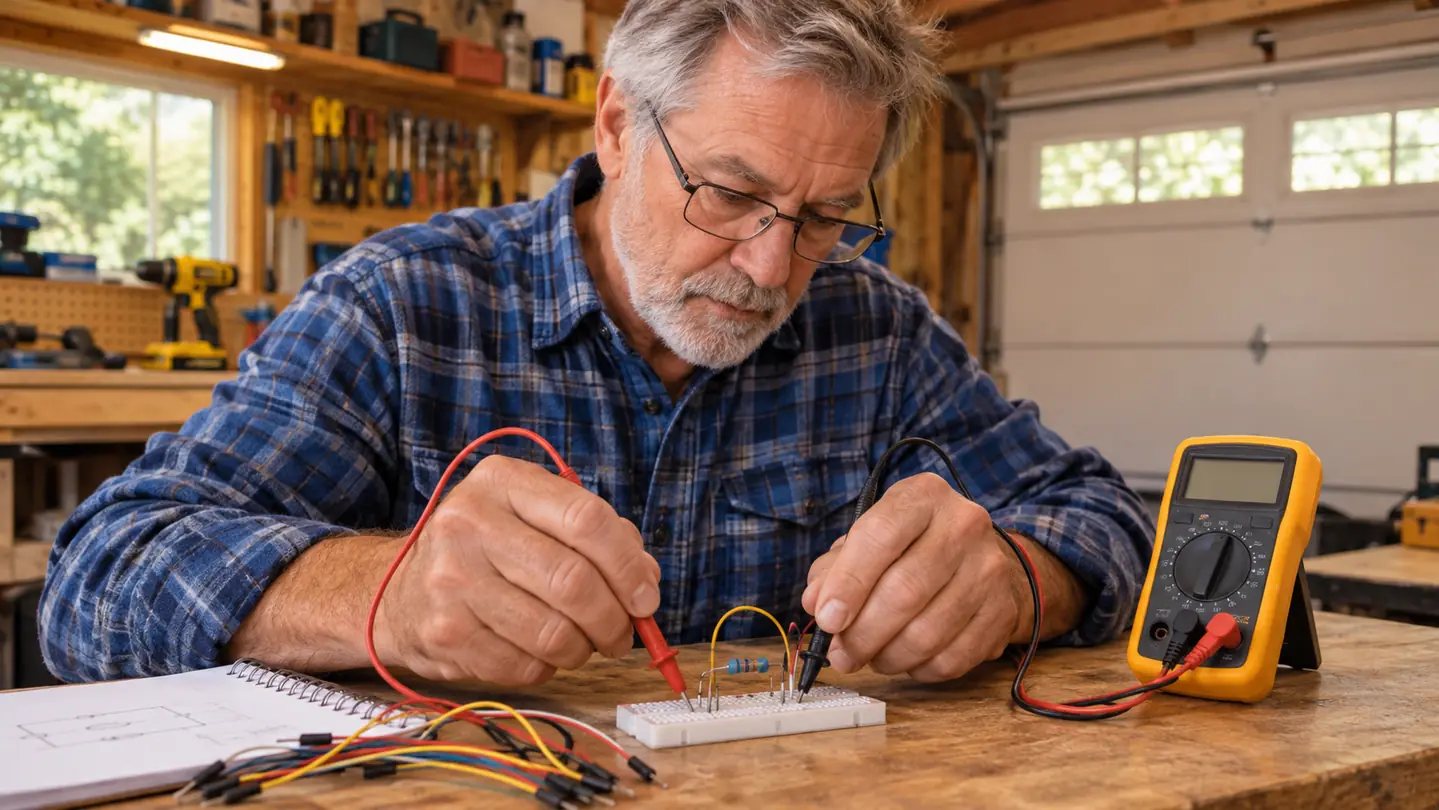
The clearest example came a year later, with the robot car. I built it over two Saturdays, about six hours of assembly at the bench. On the first Saturday I got ahead of myself and plugged one sensor cable into the wrong port. Power on, and the car sat there like a brick with ambitions. The old me would have spent the afternoon pulling connectors and second-guessing the instructions. Instead I checked the battery voltage with the meter, saw a healthy reading, and knew the power side was fine. That sent me straight back to the wiring diagram, where I found the cable in the wrong port. About ten minutes in all. One cable moved. The car drove.
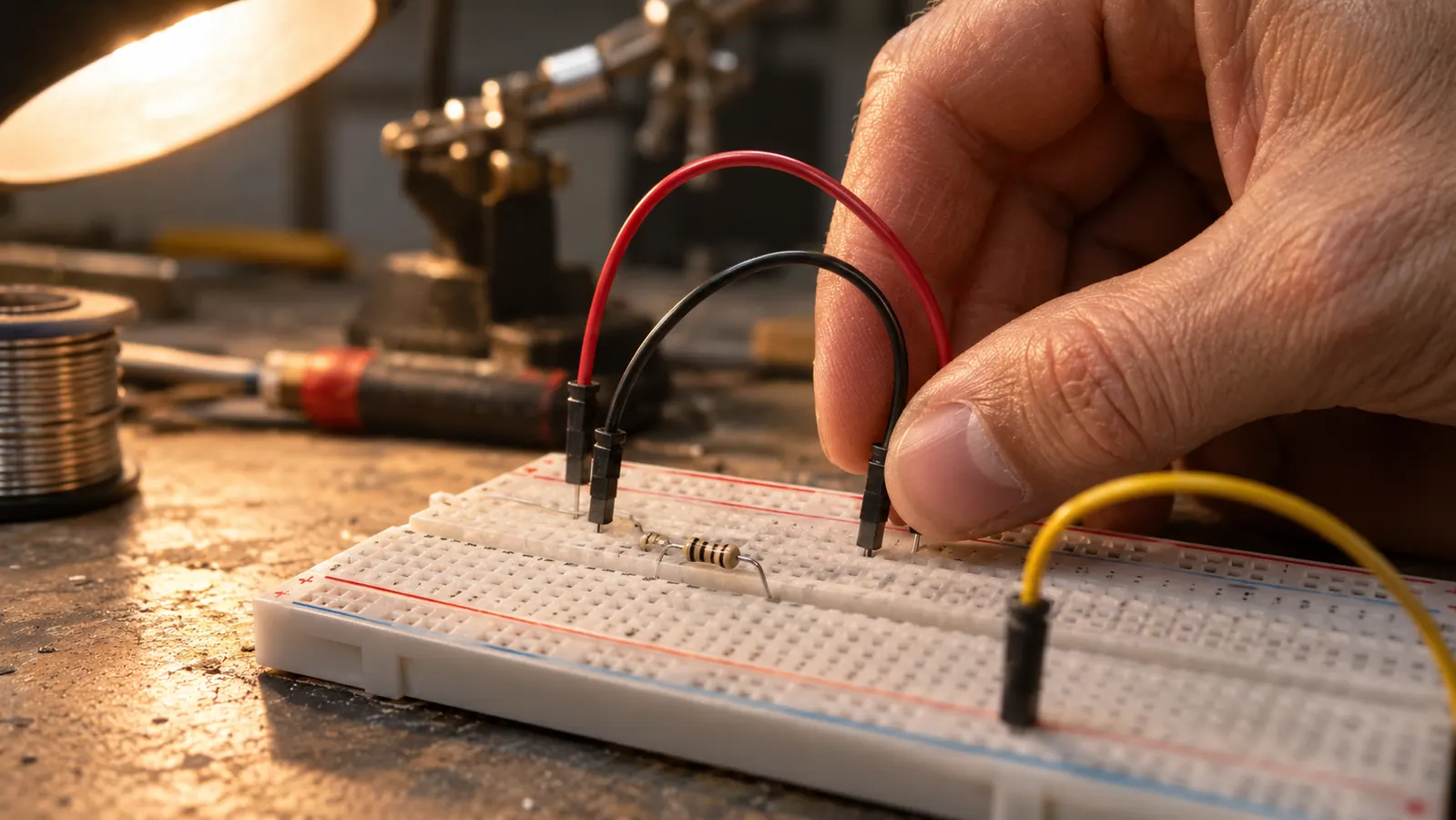
The other job it does constantly is check a resistor before it goes into a breadboard. In May 2024 I wired an LED without its resistor and burned it out, one LED and nothing else, but it taught me the habit. Now I measure the part first, read the value, then place it. That takes fifteen seconds. It has saved me more debugging time than any tutorial I have read, because a wrong resistor is invisible once it is seated in the board.
Ten minutes with a meter beat the whole afternoon I used to spend swapping parts I was sure were fine.
The meter that ended the guesswork on my bench
AstroAI AM33D, 2000 counts. DC and AC volts, resistance, continuity and diode. Ships with the 9V battery, two test leads and a manual, and it carries a 3 year warranty.
Amazon Check today's price on Amazon →Two years and nine months in, the routine has not changed much. DC volts on a 9V battery before it goes into a build. DC volts on the 5V and 3.3V rails when a board boots and then misbehaves. Continuity on a suspect wire. Resistance on a resistor. It samples about twice a second, slow enough that I can watch the number settle and fast enough that I am not standing there waiting on it. The backlit screen matters more than I expected, since the garage lamp sits behind my shoulder and my own shadow falls straight across the bench.
What it will not do is worth saying plainly. The listing notes that it cannot test all AC current, and it will not read AC voltage below 100 millivolts. It tops out at 500 volts, and the stated operating range is 32 to 104 degrees Fahrenheit, which is fine for a garage in Everett and not fine for a cold driveway in January. It arrived with the 9V battery, the leads and a manual, and it meets IEC 61010. I replaced the battery once, in spring 2026. I have never put it on household mains wiring, and I would not encourage anyone to start there.
The part I did not expect is how it changed the way I build. When you can check a thing, you stop assuming. I solder more slowly now and measure more often. That is a fair trade for a man with a bench in his garage and no supervisor looking over his shoulder. It also means I finish things. Half the kits that die on a hobbyist's shelf did not die from a bad part. They died because nobody could tell which part was bad.
What I'd Tell You If We Were Sitting at My Kitchen Table
I would tell you the meter is not the interesting part of the hobby. The interesting part is the moment a circuit does what you intended, and everything before that moment is usually a guessing game. Buy the meter before you buy the third spare board. Learn continuity first, because it answers the question you will ask most often, which is whether the wire you are looking at is actually connected to the thing you think it is connected to. Then learn DC volts, and learn to read the number instead of just glancing at it.
I would also tell you not to expect it to teach you electronics. It will not. It is a flashlight pointed at the problem. The understanding still has to come from you, from the schematic and from the slow work of comparing what you built against what you meant to build. Carol still asks what it does. I still tell her it tells me the truth, and after two years and nine months at this bench, that has turned out to be the whole job.
Still the first tool I pick up, two years and nine months later
Continuity, DC volts, resistance and diode on a 2000 count screen. The 9V battery that came with it lasted until spring 2026. If a dead project is costing you weekends, start here.
Amazon See the AstroAI AM33D on Amazon →