
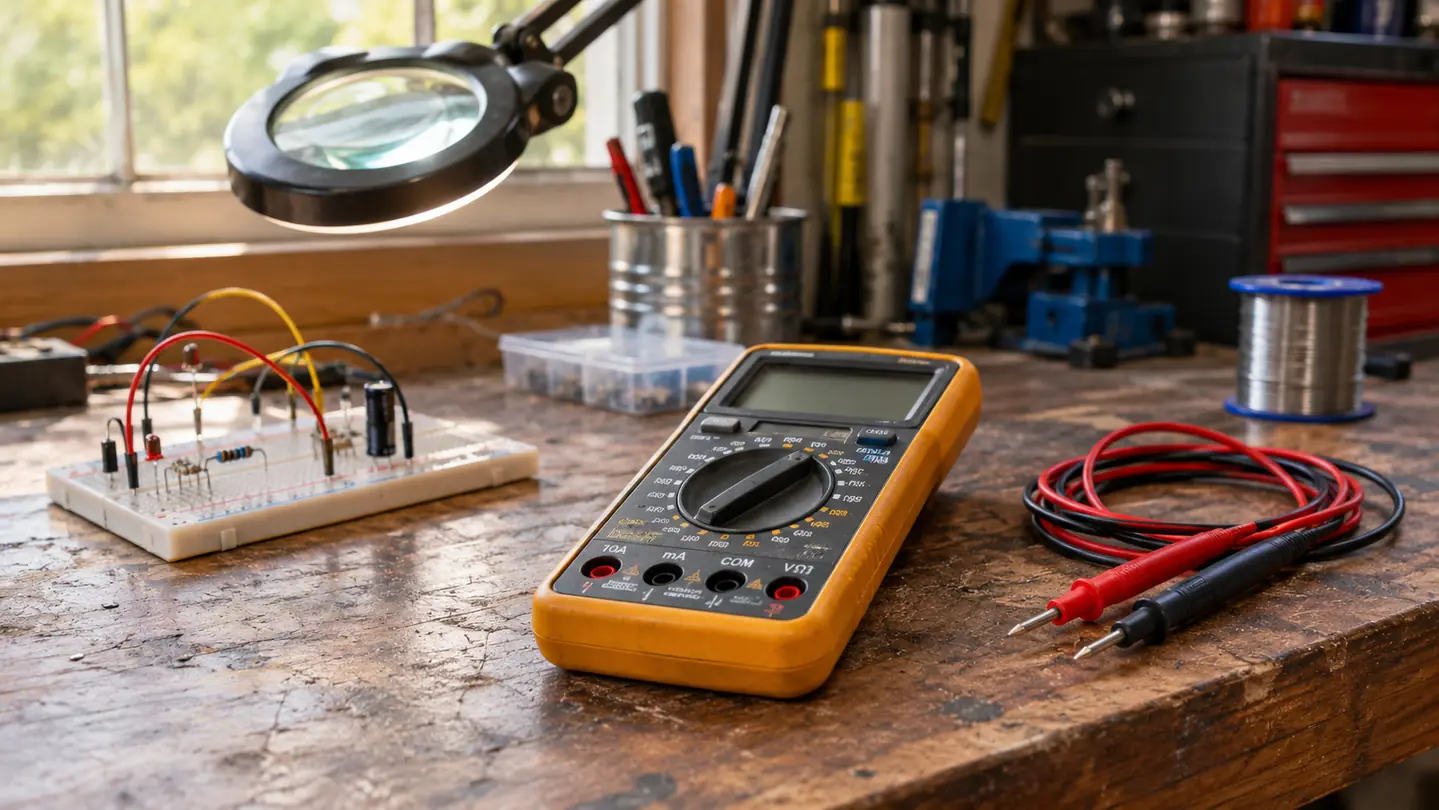
Thirty-four years of my working life went into chasing electrons through airplane wiring, and in all that time I never owned a multimeter. The hangar issued them. You signed one out at the start of a shift, you signed it back in at the end, and it never crossed my mind to buy one for myself until the first morning of my retirement, when I walked out to the garage bench and found nothing on it but a coffee ring, a drawer of loose screws and a pair of wire strippers.
The AstroAI AM33D was the first thing I ordered, in February 2024, about three months after I hung up my badge. It was a small purchase and I expected very little from it. The listing promised 2000 counts, DC and AC voltage, resistance, current, continuity and a diode check, and the review count sat above fifty thousand even then, which is why I picked it over the cheaper unbranded ones. Two years and nine months later it still sits within arm's reach, and I have used it more often than any other tool I own, including the soldering station I bought a month after it. This is what that stretch of time taught me, told plainly, including the parts that annoy me.
The Quick Verdict
An honest small meter that does continuity, DC volts, resistance and diode checks without fuss. It admits it will not measure all AC current, and I would not take it near household mains. For a bench full of breadboards it has earned its spot.
Amazon Check Today's Price →The meter that has lived on my bench for two years and nine months
For continuity checks, battery voltage, 5V and 3.3V rails and resistor values, this is the tool I reach for first. It ships with the 9V battery, two test leads and a manual, and AstroAI backs it with a three year warranty.
Amazon Check Today's Price on Amazon →How I've Used It
My work was aircraft systems, not hobby electronics, and I want to be clear about that because it shapes what this review can and cannot tell you. I did not spend 34 years building robots. I spent them troubleshooting wiring harnesses and circuit boards against a manual, with a shop meter in my hand and a second pair of eyes signing off on the result. What transferred to the garage was the habit rather than the skill: check the obvious thing first, write the number down, and do not guess when you can measure. A bench meter is the cheapest way I know to stop guessing, and that is the only claim I will make for it.
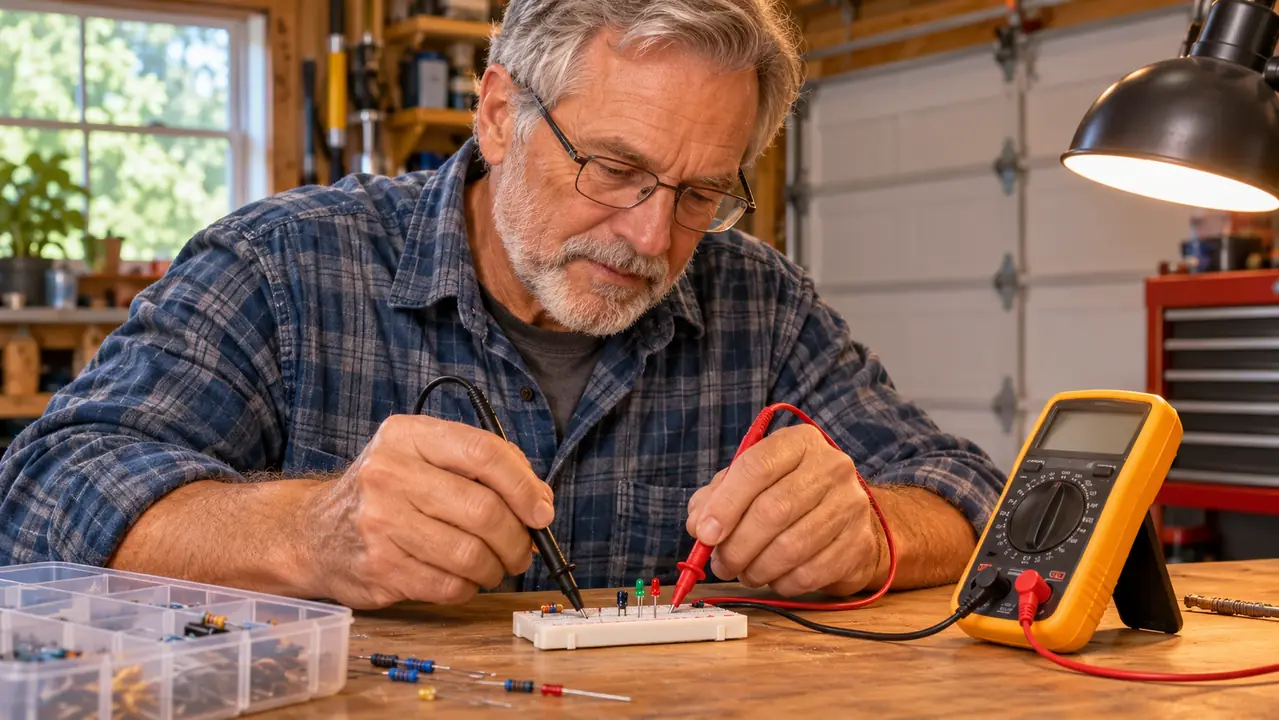
On my bench this meter does four jobs. It checks continuity on a splice or a jumper wire before I trust it. It reads DC voltage on a battery, on the 5V rail of the ELEGOO board, and on the 3.3V pins when a lesson behaves strangely but not strangely enough to explain itself. It measures resistance so I can sort a handful of loose resistors before they go into a breadboard, because the color bands on a 220 ohm and a 2.2k ohm look identical after forty years behind a magnifier lamp. And it does a diode check when I suspect I have put one in backwards, which I have done more than once and will probably do again.
I should mention what I do not use it for, because that is just as informative. I do not use it to chase current through a live circuit, which means breaking the circuit and putting the meter in series, and I have watched too many people blow a fuse doing it in a hurry. The listing is upfront that not all AC current ranges are covered, and DC current work is something I leave to people who do it often enough to keep the habit sharp. The voltage, resistance, continuity and diode functions are the four that matter at my bench, and they are the four I have leaned on for nearly three years.
None of those tasks are glamorous. They are the ones that stop you from spending an entire evening chasing a fault that turns out to be a jumper wire pushed into the wrong row. The AstroAI has done them without complaint since February 2024, and the only thing I have replaced in that time is the 9V battery it came with, changed in the spring of 2026.
What 2000 Counts Actually Means at a Breadboard
A 2000 count meter resolves roughly three and a half digits, which sounds like a specification until you translate it into bench terms. Read a rail that should sit at 5.00 volts and the display will show you something like 4.98 or 5.02, with two decimal places on the higher DC settings and a third on the lower ones. That is enough to tell you which side of the target you are on, and enough to catch a supply sagging under load or a resistor that has drifted out of tolerance. It is not enough for work that needs four or five digits of certainty. If your job requires that, you already know, and you are not shopping at this end of the shelf.
The listing states a sampling rate of two readings per second. You notice it when you are watching a value move, because the display steps rather than glides, and a slowly falling battery reads as a short series of numbers instead of a smooth slide. I found it steady rather than slow and stopped thinking about it inside a week. The backlight matters more than I expected it to. My bench lamp throws a shadow directly across the meter whenever the magnifier is swung out over a board, and the backlit display is the difference between reading the number and tilting my head around it like a confused dog.
Continuity, Resistance, and the Settings I Actually Touch
Continuity is the setting I touch most, by a wide margin. Nine times out of ten, when a breadboard circuit does nothing at all, the fault is a wire that is not seated or a rail that is not connected where I believe it is. Touch the probes to both ends, listen for the tone, and you have either cleared the suspect or found your problem in about four seconds. The meter beeps promptly on a good connection and stays silent on an open one. There is no lag long enough to make you second-guess the result and pull the probes off to try again, which is the usual failure of a slow meter.
Resistance checks come second. I keep a small drawer of salvaged resistors and I no longer trust my eyes on the bands, especially the red-red-brown family. Clip the leads across the legs, read the number, drop it in the right bin. The same setting lets me confirm a potentiometer sweeps smoothly instead of jumping, which is a fault you can hear in a circuit but cannot see on the part itself. Diode check comes third, and it has saved me from a backwards LED more than once. The meter shows the forward drop when the orientation is right and shows nothing when it is wrong, which is about as clear as a diagnostic gets.
The Honest Limits: AC Current and the 100 mV Floor
The listing is unusually candid about two limits, and I want to repeat them plainly, because they are the reason a few buyers will be disappointed. This meter cannot test all AC current ranges, and it will not read AC voltage below 100 millivolts. If your work involves measuring AC current, you need a different instrument, and the seller says so on the product page rather than burying it in a footnote. A clamp meter is the usual answer for that job. I have never owned one at home, though I watched them used at the hangar for years, and I would not pretend to review one from this bench.
The second limit is more of a boundary. This is a bench meter for low voltage work. The listing rates it to a maximum operating voltage of 500 volts, cites IEC 61010, and gives an operating temperature range of 32 to 104 degrees Fahrenheit, which describes my garage on all but the worst week of the year. I have never put mine near household mains wiring and I would not encourage anyone to start. My bench runs 5 volts, 9 volts, 12 volts and the occasional 24. For that it is the right tool. For a wall socket, call an electrician or buy a meter built and rated for the job, and read the manual either way.
One practical note on that temperature range. Thirty-two to 104 degrees Fahrenheit sounds like a formality until you leave a meter in an unheated garage through a cold snap. Mine lives indoors in a drawer and comes out to the bench when I work, which is part of why it still reads true. If yours will live in a shop that freezes, bring it inside for the winter and let it come back to room temperature before you trust a number off it.

Two Years, One Battery, and the Parts Nobody Mentions
The meter arrived with a 9V 6F22 battery, two test leads and a paper manual. The battery lasted from February 2024 into the spring of 2026, a little over two years of regular evening use, and the low battery indicator gave me fair warning before the readings started to wander. That is the entire failure history. Nothing has cracked, nothing has come loose, and the lead sockets still grip firmly after all that time.
The manual is thin but adequate for what the meter does, and I would say the same about the leads: ordinary, not deluxe. If you spend an evening probing fine pitch header pins you will want a set of finer probes, and I would call that a small upgrade rather than a complaint. The unit weighs 0.15 kilograms, light enough to slide around the bench one-handed and heavy enough that it does not tip when you push a probe into a tight header. AstroAI also states a three year warranty and a California based support team that answers within 24 hours. I have never had cause to test either, so I will not claim more for them than the listing does.
I still have the memory of shop meters to compare against, and the honest version is this: a calibrated hangar instrument is a different class of tool, and it should be. It cost more, it was checked on a schedule, and somebody else's signature depended on its accuracy. The AstroAI is not that and does not claim to be. What it is, is a small meter that reads the same value three evenings running on the same resistor, which is the property I actually care about at a bench where nobody is signing off on anything.
What I Liked
- Continuity tone is immediate, and continuity is the setting you will use most
- Backlit display stays readable when a magnifier lamp throws a shadow across the bench
- Ships with battery, two test leads and a manual, so it works out of the box
- Low battery indicator gave clear warning before readings drifted
- Rated to 500 volts and cites IEC 61010, with a three year warranty
Where It Falls Short
- Cannot measure all AC current ranges, stated plainly on the listing
- Will not read AC voltage below 100 millivolts
- Two readings per second makes a drifting value step rather than glide
- Included test leads are ordinary, finer probes are a separate buy
Nine times out of ten, when a breadboard circuit does nothing, the fault is a wire that is not seated. The meter tells me that in about four seconds.
Who This Is For
This is for the person who has started building circuits and has run into the wall where guessing stops working. If you are working through a starter kit and a lesson will not light up, you need to know whether the problem is the code, the wiring or the part, and a meter is how you separate those three. It suits a bench that runs on 5 and 9 volts, a drawer of rescued components, and a habit of checking a connection before you solder it. It also suits someone who wants a second meter to leave set up on one task so they are not re-probing the same joint every ten minutes.
Who Should Skip It
Skip it if you need AC current measurement, if you work on household wiring, or if your work needs four or five digits of resolution. Skip it if you troubleshoot at a professional level where meters are calibrated on a schedule and results are logged, because that is a different purchase with a different paper trail. And skip it if you want one tool that covers everything. This one does a handful of jobs well and says plainly what it will not do, which after 34 years of reading specification sheets is a quality I have learned to prefer over a page that promises the world.
If a breadboard circuit has you stuck, this is the four-second answer
Continuity, DC volts, resistance and diode checks in one small meter, with a backlit display, a battery in the box and a three year warranty. It has been on my bench since February 2024 and it is not going anywhere.
Amazon Check Today's Price on Amazon →