
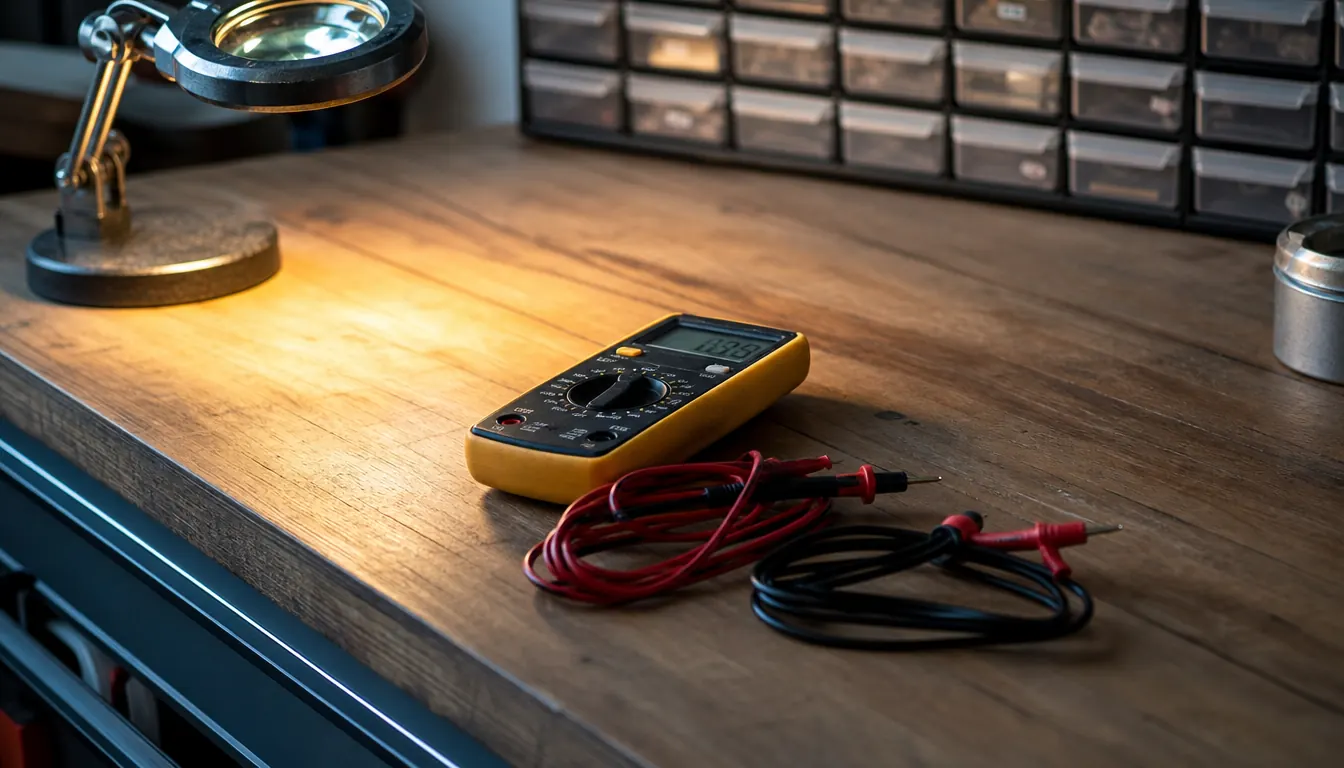
Most AstroAI reviews tell you the same four things. It is inexpensive, it works, it has a backlight, and the leads are fine. All of that is true, and none of it is the part that decides whether this meter belongs on your bench. The part that decides is the number in the product name, and almost nobody explains what that number is. So let me start there, because a 2000-count meter is a specific instrument, and most of the arguing about it online is really an argument about which specific instrument somebody thought they were buying.
I bought the AstroAI AM33D in February 2024, three months after I retired from thirty-four years of aircraft avionics work. Here is the detail I am not proud of. In all that time I had never owned a multimeter. The hangar issued them. I carried a shop meter worth more than my truck, signed it back in at the end of shift, and never once thought about what a home meter ought to be. So when I finally bought one for the garage bench, I bought the one with the reviews and the three-year warranty and did not think much past that. Two years and nine months of steady use later, it is still the only meter on that bench. It has been dropped, left out in a cold garage, and asked to do the same handful of jobs over and over. I have a clear picture now of what it does well, where it quietly stops helping, and who should not buy it.
The Quick Verdict
A dependable bench meter for batteries, rails, resistors and continuity, held back by a display that runs out of resolution exactly where hobby work starts to get interesting. Buy it for the jobs it can do, not the jobs you picture it doing.
Amazon Check Today's Price →Two years and nine months on one garage bench, and it still does the job
The AstroAI reads 5V and 3.3V rails, checks resistor values before they go into a breadboard, and has been through exactly one 9V battery. If that is your bench work, this is your meter.
Amazon Check Today's Price on Amazon →How I've Actually Used It
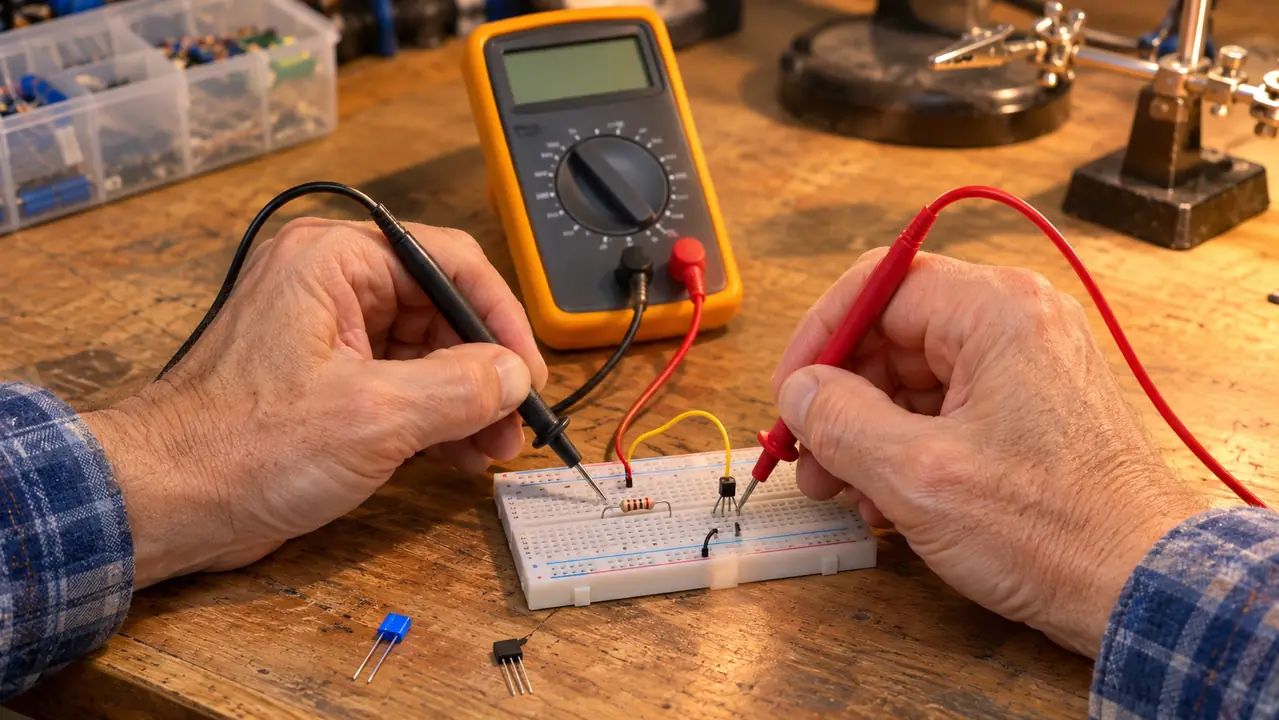
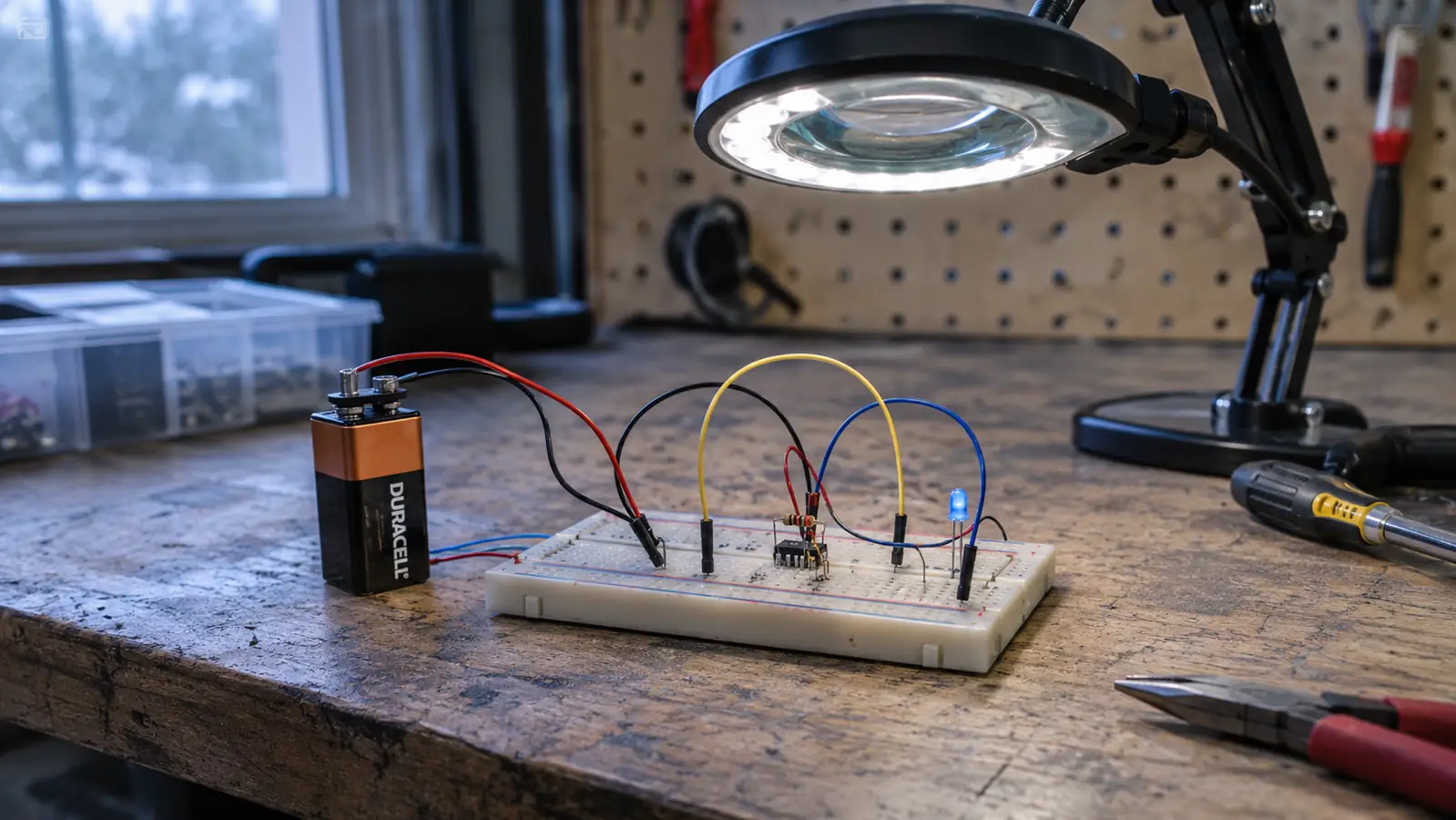
The work is not glamorous. I check AA and 9V batteries before I trust them in a project. I check the 5V and 3.3V rails on a breadboard before I plug anything into them, because a rail that sags under load will send you hunting through code for a problem that is not in the code. I measure resistors before they go into a circuit, so I do not spend an evening debugging a value I pulled from the wrong drawer. On the Raspberry Pi at the right end of the bench, the meter confirmed the supply rail before anything else got blamed for a bad boot. That is ninety percent of what a hobby meter does, and the AstroAI handles all of it without complaint.
Continuity is the function I reach for most. Tracing a wire from one end of a harness to the other, confirming a solder joint is solid and not cold, checking that a header is seated all the way down. You touch the leads together first and confirm the meter is telling you the truth, then you work through the connections one at a time. It reads twice a second, per the listing, which sounds slow written down and feels perfectly fine in the hand. You are not staring at a display. You are working through a list of things and getting a yes or a no on each one.
The resistance side is where the counts first matter. A 4.7k resistor gives a stable number with enough digits to know you grabbed the right part. A 470 ohm gives the same. When I have wanted to know whether a very small resistance was intact, the test leads themselves got in the way, and no meter at this resolution can separate the resistance of the leads from the resistance of the thing you are measuring. I stopped expecting it to. That is the first honest limit, and it is not AstroAI's fault. It is arithmetic.
Power is a plain 9V, the kind that comes in the box. The one it arrived with lasted until spring 2026, a little over two years of intermittent bench use, and the low battery indication gave me notice before it went flat. I replaced it and moved on. No charging, no dock, no cable, nothing to lose.
What 2000 Counts Actually Means
A count is the largest number the display can show before it rolls over and you have to move up a range. Two thousand counts means the display tops out at 1999. That is the entire definition. It is not a build quality score, it is not an accuracy figure, and it says nothing about how long the thing will last. It tells you how finely the display divides whatever range you are working on, which is a narrower piece of information than the way the number gets used in product listings.
Here is the arithmetic, because it is not complicated and it explains every complaint below. On a range where full scale is twenty volts, 2000 counts puts the last digit at one hundredth of a volt. That is plenty for a 5V rail, a 3.3V rail, a 9V battery, or a pair of AAs. You can watch a rail sag in hundredths when you add a load, which is exactly the lesson a beginner needs to see happen with their own eyes. On a range where full scale is two volts, the last digit lands in millivolts, and that is finer than most hobby work will ever ask for.
Where it runs out is at the edges. The listing is unusually direct about one of them: the meter cannot read below 100 mV of AC voltage. If you are chasing a small AC signal, this is not the instrument, and no amount of technique will make it one. It also states that the meter cannot test all AC current. I have never needed AC current at the bench, so that limitation has cost me nothing, but you should know it is there before you buy rather than after.
The other edge is the top. Maximum operating voltage is listed at 500 volts. Treat that as a ceiling to stay well under, not a target to approach. I have never come close to it.
The Limits, Stated Plainly
Two things made me stop thinking of this as a general-purpose meter and start thinking of it as a bench meter. The first is the resolution at the very low end, which I described above. The second is simply that it is a 2000-count instrument, and a good deal of interesting hobby work now sits comfortably beyond that. Neither of those is a malfunction. They are the shape of the tool.
I want to be fair here, because it is easy to turn this into a criticism the product does not deserve. Nothing about the AstroAI is dishonest. The count is in the product name, the AC limits are printed in the listing, and the listing does not pretend otherwise. If you buy a 2000-count meter expecting the resolution of a 6000-count meter, that is a reading problem rather than a manufacturing one. My only complaint is that listings in general push beginners toward a purchase before explaining what the number means.
The temperature spec deserves a mention for anyone working in a garage. It is rated from 32 to 104 degrees Fahrenheit. My bench runs along the back wall of a two-car garage in Everett, and in January that wall is cold enough that I check the thermometer before I trust a reading. Below freezing the meter is outside its stated range and I leave it inside. Above 104 has never been a problem I had to solve.
Two years and nine months, one 9V battery replaced in spring 2026, and not a single reading I could not explain. That is the whole case for it.
The Parts That Annoy Me
The test leads are the weakest thing in the box. Two leads, standard length, and they stiffen up in cold weather. Stiff leads are a small annoyance that becomes a real one when you are trying to hold two contact points and read a display at the same time. I have thought about buying better leads more than once and have not, which tells you how much it actually bothers me in practice.
There is no case. What ships is the meter, a 9V battery, two test leads and a manual. Mine lives on the bench, so this has never mattered to me. If you plan to carry it in a tool bag, plan on wrapping it in something first.
The display has a backlight, and I did not expect to use it as much as I do. A garage with one overhead light and a magnifier lamp is not a bright room, and reading a display at an angle is where a backlight earns its place. That part of the design I have no complaints about at all.
Beyond that my complaints are small and mostly philosophical. It reads twice a second. It is not a fast instrument and it does not pretend to be one. What it does, by being slow and simple, is make you stop and think about what you are measuring. For a beginner that is not a limitation. That is the entire point of the exercise.
What I Liked
- Continuity checking quick enough to trace a harness by feel
- Backlit display that is genuinely readable in a dim garage
- Runs on a standard 9V, and the low battery indication fired before it went flat
- Three-year warranty and IEC 61010 listed in the paperwork
- The listing states its own AC limits instead of burying them
Where It Falls Short
- 2000 counts runs out of resolution at the low end of resistance work
- Cannot read below 100 mV of AC voltage
- Cannot test all AC current
- No carry case, and the included leads stiffen in the cold
- No category safety rating listed, so it stays on the bench and off mains wiring
The Warranty, the Support, and the Safety Paperwork
The warranty runs three years through AstroAI, and the listing says their support team is based in California and responds within 24 hours. I have not tested either one, because nothing has failed. What I can tell you is that the meter lists compliance with IEC 61010, the standard covering measurement equipment, and that the manual is short enough to actually read once.
What the listing does not give you is a category safety rating. I am going to be direct about this, because it is the one place where an inexpensive meter deserves your full attention and most reviews skip past it. On a bench, measuring batteries and low-voltage rails, the absence of a category rating costs you nothing. On household mains wiring it is the difference between a tool and a hazard. I have never used this meter on mains wiring and I would not, and that is not a knock on AstroAI in particular. It is simply what the paperwork supports, and I am not going to claim more for a device than its own listing does.
The same restraint applies to the rest of it. It lists IEC 61010, so I say it lists IEC 61010. It does not claim a category rating, so I do not give it one. If you need a meter for panel work, buy a meter rated for panel work.
What I'd Tell a Beginner Before They Open the Box
First, learn what the ranges mean before you learn what the features do. A meter that reads 0.00 tells you something very different from a meter that reads 0.00 on the wrong range, and the display will not warn you either way. Sit with the manual for fifteen minutes and measure a battery whose voltage you already know. That single habit will save you more time than anything on the feature list.
Second, accept that the leads are part of the measurement. Touch them together and see what the meter reads. That number sits inside every resistance reading you take afterward, and knowing it is there will stop you chasing a fault that is actually your own equipment.
Third, do not buy this meter imagining the jobs it cannot do. Buy it for continuity, batteries, rails and resistor values. If you later need to read below 100 mV of AC or want AC current in the general case, that is not a reason to be disappointed in the AstroAI. It is a reason to own a second meter, and there is nothing unusual about owning two.
Who This Is For
Buy this if your work lives between roughly 1 volt and 20 volts and mostly on the DC side. Battery checks, rail checks, continuity, resistor values before they go into a board. Buy it if you want a first meter that will not flatter you and will not confuse you, that runs on a battery you can buy at any hardware store, and that carries a three-year warranty. Buy it if you are the sort of person who wants to understand what a count is before spending more on a meter that has more of them.
Who Should Skip It
Skip it if you need to measure below 100 mV of AC, because the listing says so and I have no reason to doubt it. Skip it if you need AC current in any general sense. Skip it if there is any chance you will work on household wiring, because there is no category rating here and you should be holding an instrument that has one. And skip it if you already know you want more resolution than 2000 counts gives you, because you will spend the next year wishing you had bought the meter you actually wanted instead of the one that was easy to buy.
The meter that earned its place on a garage bench
Continuity, DC voltage, resistance, a backlit display, and a three-year warranty. If your work is batteries and 5V rails, you already know what you need. This is it.
Amazon Check Today's Price on Amazon →